3/1/26
For the past 13 months, Byron Peak never strayed far from my attention. Brian Peters and I did everything we could to nail the conditions in February of 2025, but were stymied by the classic unpredictable weather that defines Portage Valley. Throughout the summer of 2025 I took multiple trips to Portage, and each trip started by glassing Byron and collecting photos to help unlock the peak. Now, 13 months later we found another window with all the elements we needed for success; clear skies, stable snow, and cold temperatures. Given this perfect set-up, we knew all we could do was get on the mountain and hope that weather cooperated with us long enough to allow passage to the summit.
Aaron Maves and I had skied the Banana Couloir on Pinnacle in Hatcher Pass the day before, and in our typical style, we were making plans for what we’d ski the next day before we had even dropped into our line. A thin and pitiful snowpack in Hatcher turned our eyes towards Portage, so when I saw the stars aligning for Byron, I was excited to pitch the idea. Aaron agreed he was in, and Brian Peters did not hesitate to join after I texted him “So, we were thinking Byron tomorrow. It’d be blasphemy for you not to join.” With our team assembled, we headed off for Portage before sunrise.
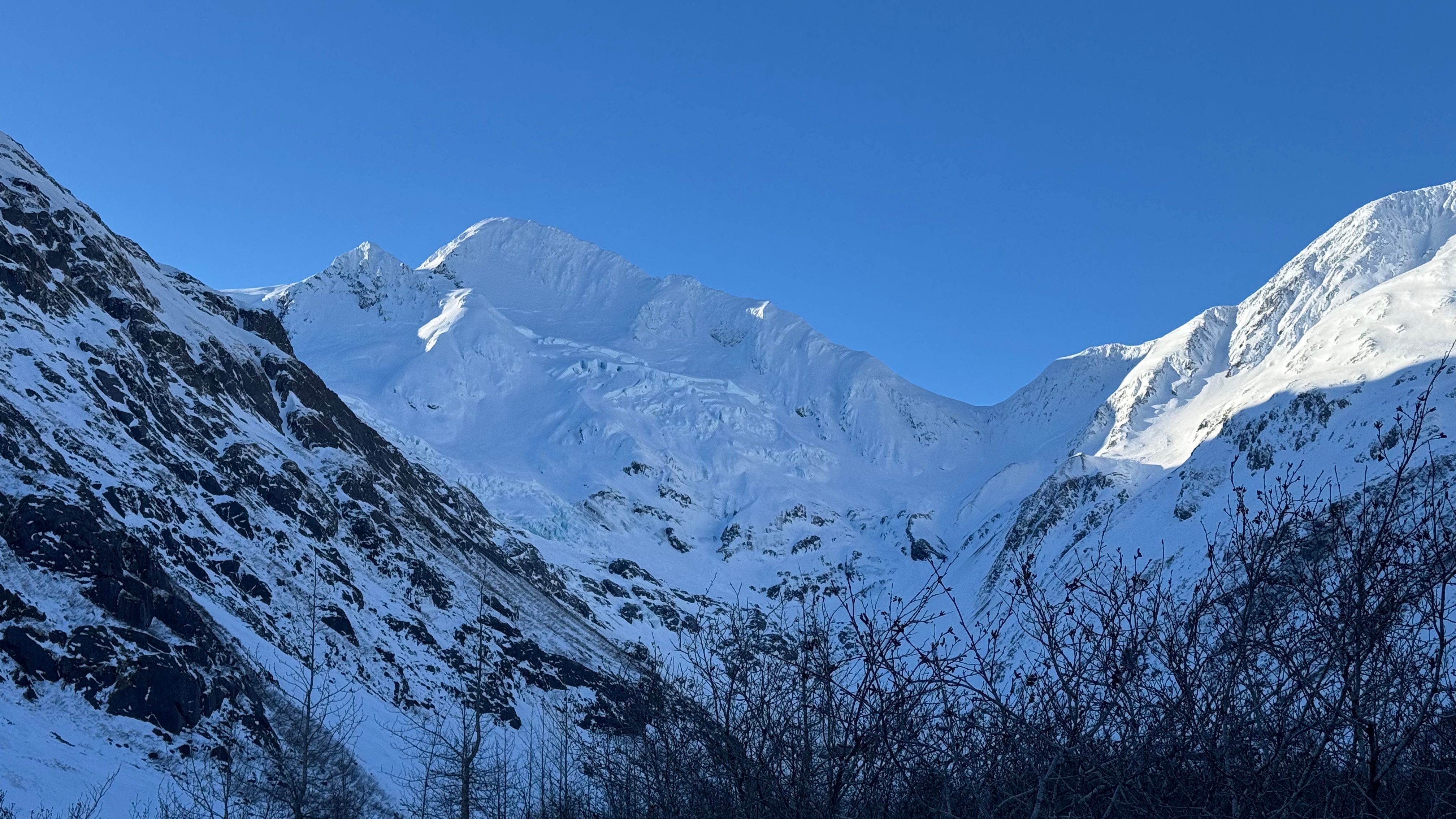
Byron Peak underneeath perfect, blue skies
Upon reaching the Byron trailhead, we found -20°F air temps. This encouraged us to be extra slow in readying our gear and donning our boots; however, no amount of waiting will ever bring the sun into the Byron valley that time of year. Eventually we bit the bullet and started down the trail. The first two miles of the trail are trivial–just follow the summer trail and continue beyond it following the path of least resistance to the first lobe of exposed ice. We followed the west side of the valley before crossing over shallow cliff bands to get to the ice as it allowed for the easiest skinning and held the most snow.
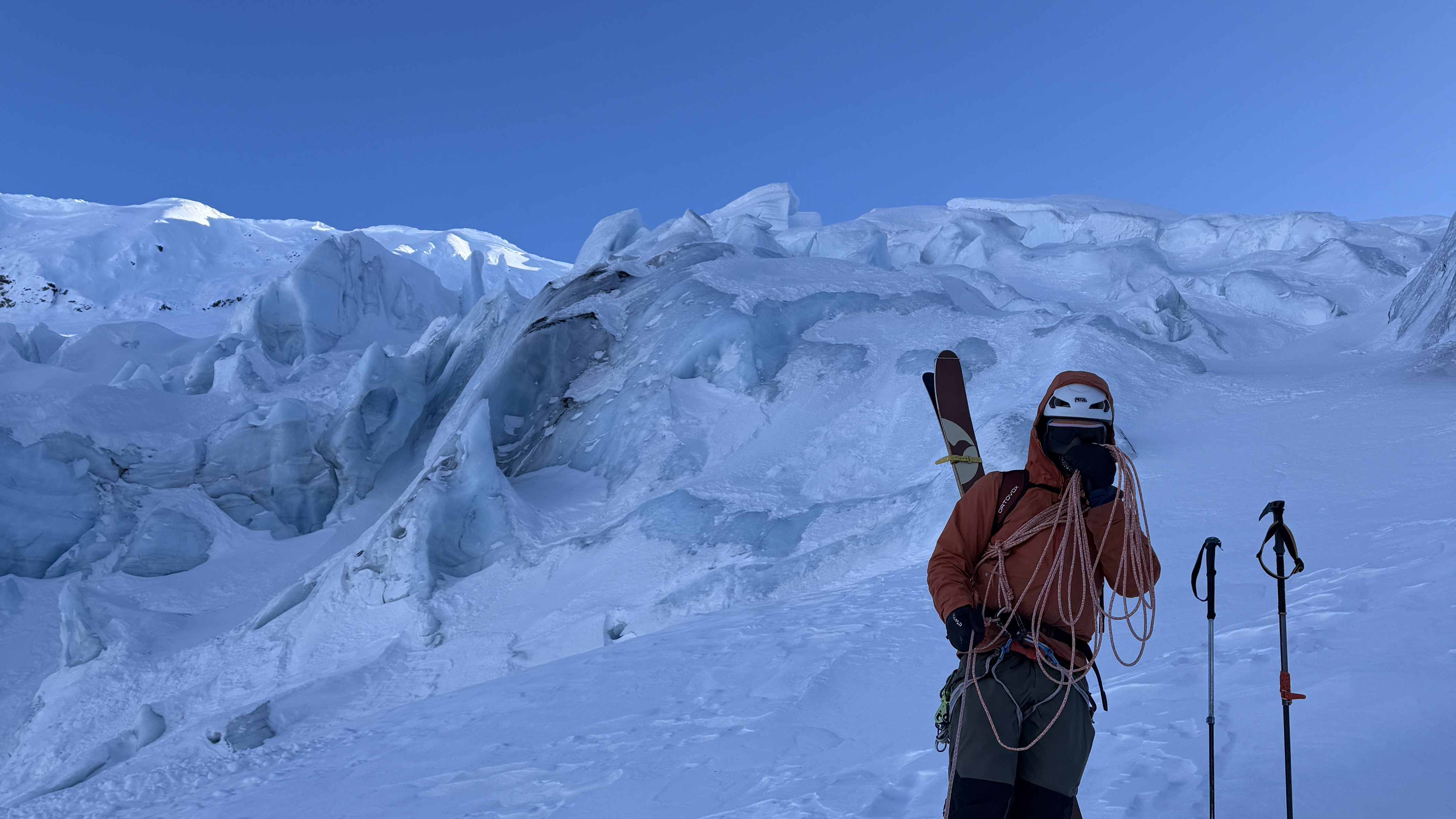
Myself bundled up trying to stay warm during a short break
Approaching the first piece of cracked ice, we found plenty of serac debris. This highlighted the importance of picking the right day to go for this objective. In a location shielded from any overhead hazard, we transitioned out of our skis and into our crampons before joining each other on a rope. Having surpassed this point last year, Brian quickly gunned up the corner between the glacier ice and the greywhacke wall, only needing to step over a couple miniscule crevasses. We followed him as he led us onto the featureless panel between the two pieces of complex ice.
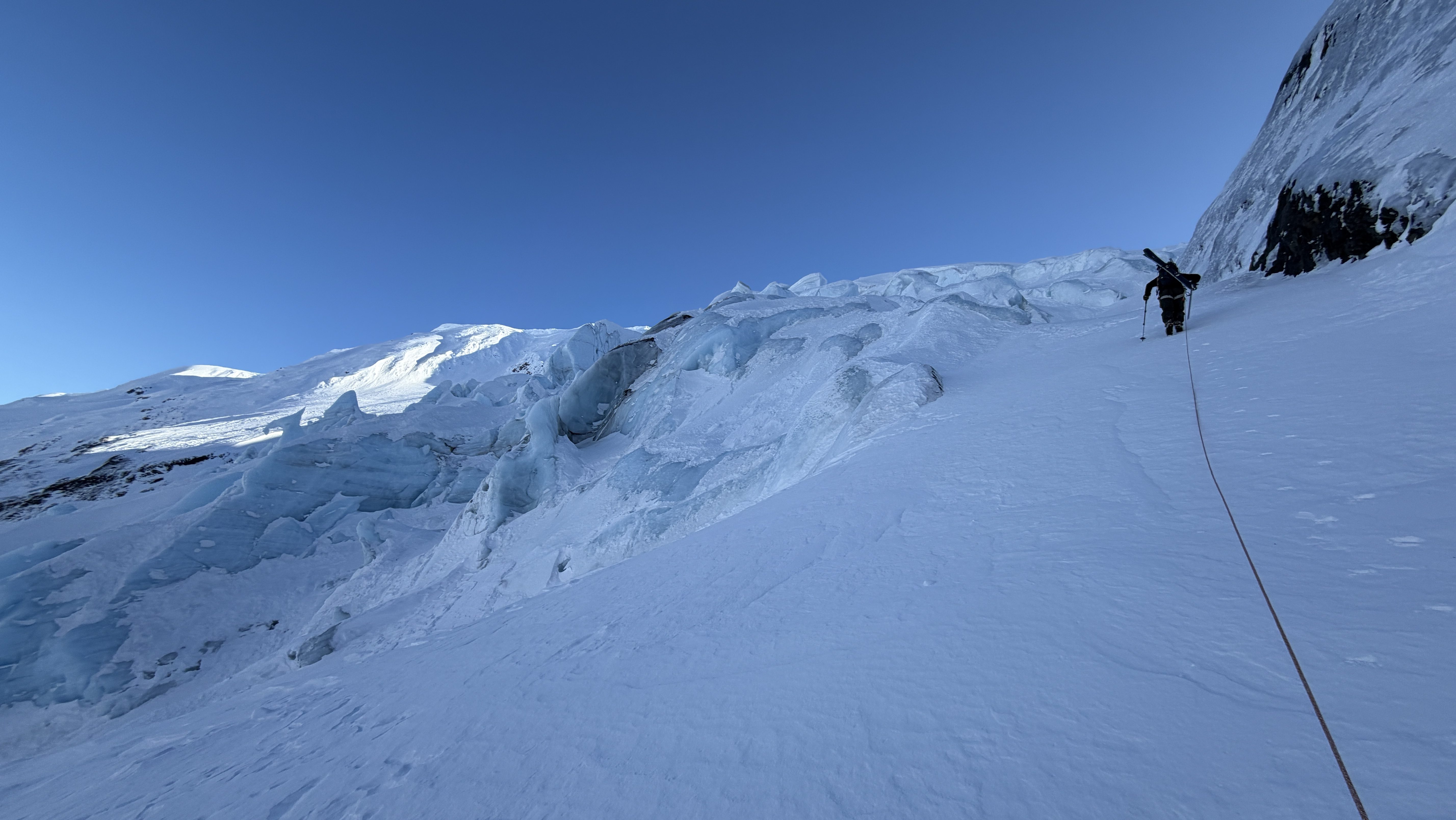
Brian leading through the first section of exposed ice
A year prior, Brian and I had reached this point but turned around due to the upper mountain becoming engulfed in a cloud, shrouding the remainder of our route. This time around, the skies remained clear allowing us to continue venturing upwards. As we passed our previous high point, I felt a sense of relief–even if we had to turn around, we had made progress on understanding the low-elevation giant. However, this relief also came with a sense of dread as now we were approaching the second, and more complex, piece of ice. Climbing the seemingly endless panel of snow towards the icefall gave plenty of time to make a plan, and the most obvious route seemed to go high above the glacier on snow slopes. This would avoid the major crevassing and put us right into the bowl underneath the headwall of the peak. As we reached this crux, Aaron began leading us up the steepening slope.
Before Aaron made it very far, Brian announced that he felt like we should talk through our options. I am glad Brian spoke up; as Aaron began up the slope, it became more and more apparent just how steep this slope was going to be. Had there been no crevasses on the slope, we would have happily pulled the rope, but the presence of cracks made it a complicated decision on if it would be better to stay roped to catch anyone who might fall in a crack or to pack the rope away to prevent an individual fall pulling down the other two people on the rope. We talked through our options, and after evaluation, we came to the conclusion that staying roped and navigating the more complex, but far less steep, main lobe of the glacier would be our safest option. Being the one who mentioned how I’d rather fall in a crack on my own accord than fall down the slope on someone else’s accord, it only seemed right that I led us through the glacier.
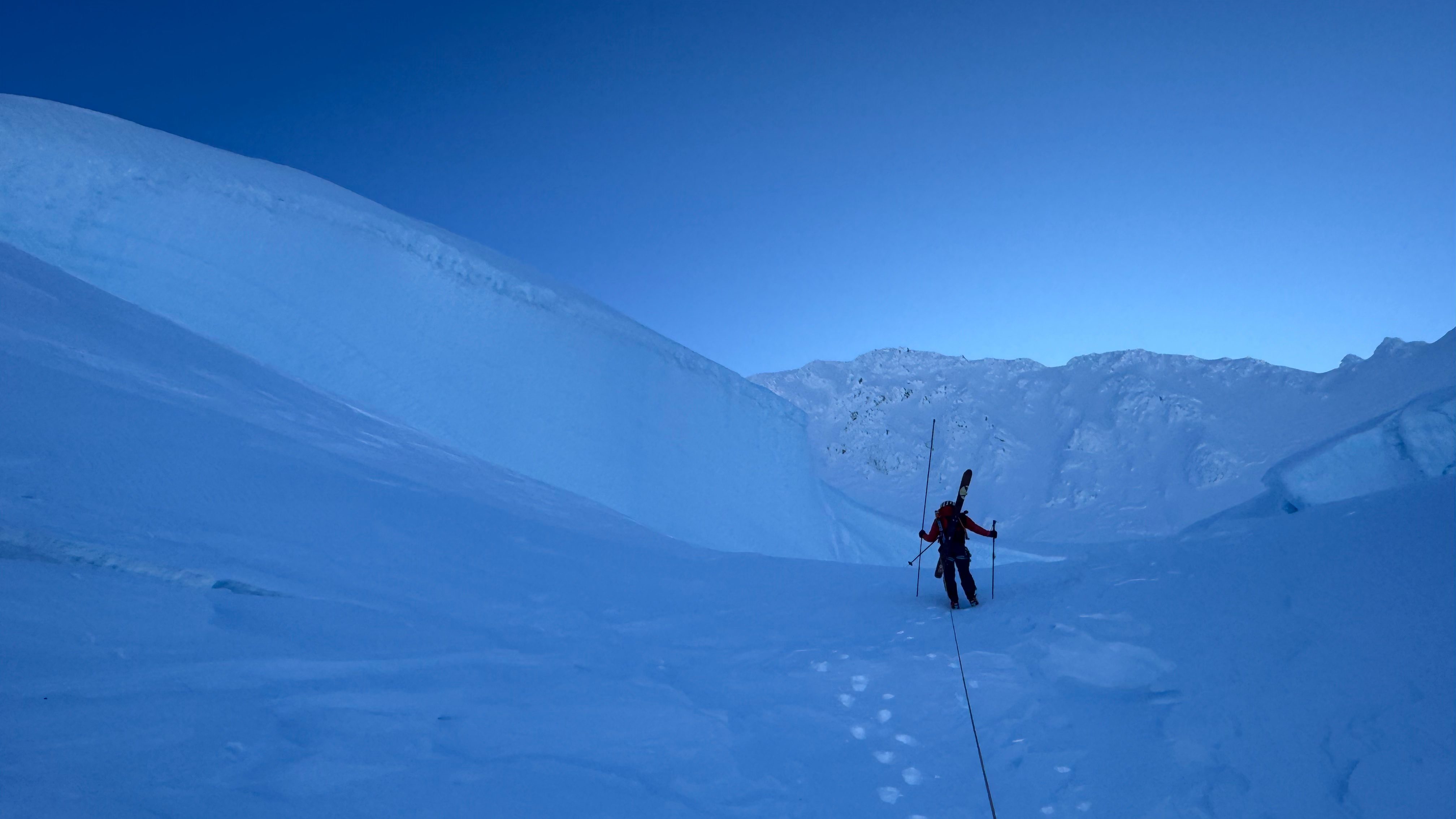
Probes out to navigate the cracked ice
I probed and found my way through the icefall while constantly reminding my partners, who already had me plenty tight, to keep the rope right. Luckily, the glacier proved to be far more straightforward than it looked. We walked over a few crevasses, but it felt like they were all too small to take any sizable fall into. From above the icefall, we were looking straight up the headwall to the summit we were seeking. We ran across the bowl quickly, but still it provided us with enough time to decide that climbing and skiing the headwall was too dangerous given the conditions. Slide-for-life snow and numerous bergschrunds and crevasses littered the face. Alternatively, taking a col to the east face offered a safer fall-line to both climb and ski.
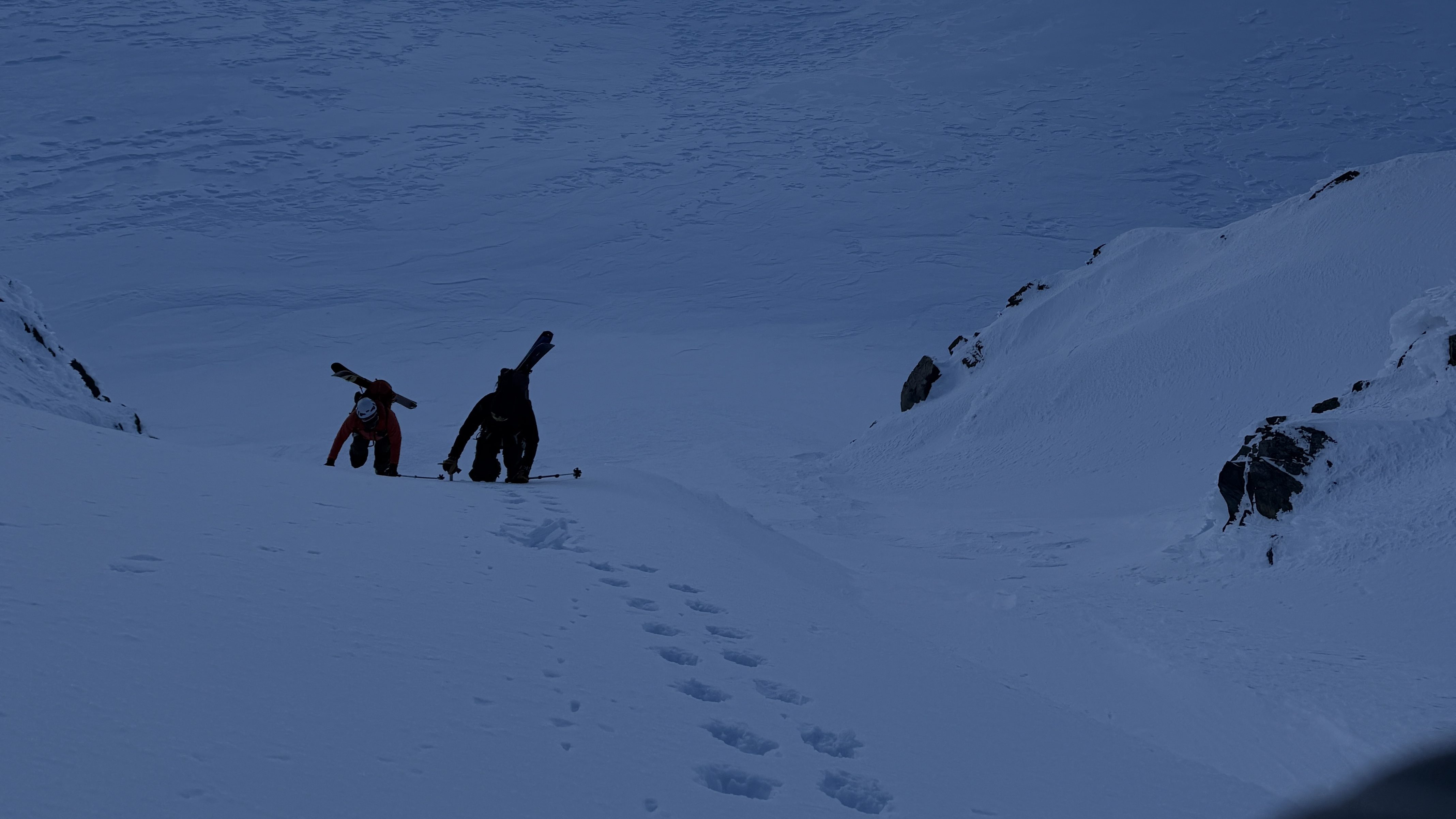
Booting up the final pitch of the east face
We booted to the col, and at the top stashed our rope and glacier kit. From there, all we had was a 750 foot boot up the east face to the peak. Filled with ambition to stand on the summit and the desire to feel sunlight, we made quick work of this face. As we pulled ourselves out of the shadows and onto the sunny peak, we all felt astonished by the views we gained. We could see both the Turnagain Arm and Prince William Sound, the High Chugach and the Alaska Range, and the endless peaks and valleys between it all. Carpathian’s south face glowed in the late-winter sun; the calls of the siren were louder than I have ever heard them.
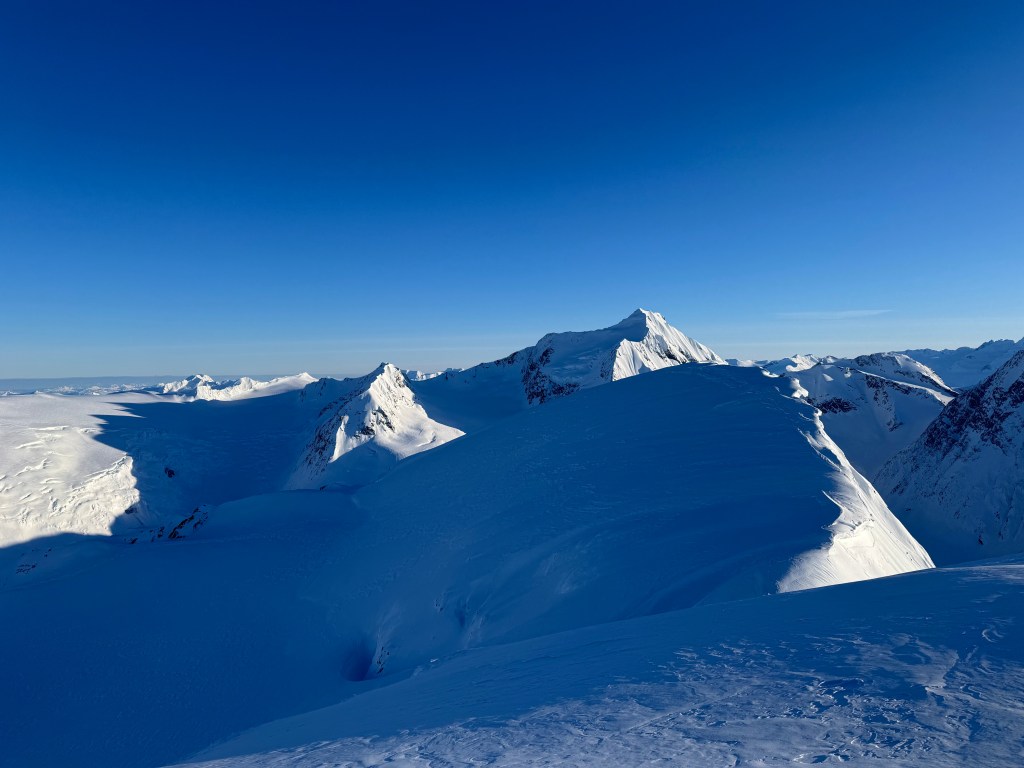
Byron’s east peak and Carpathian viewed from Byron’s west peak
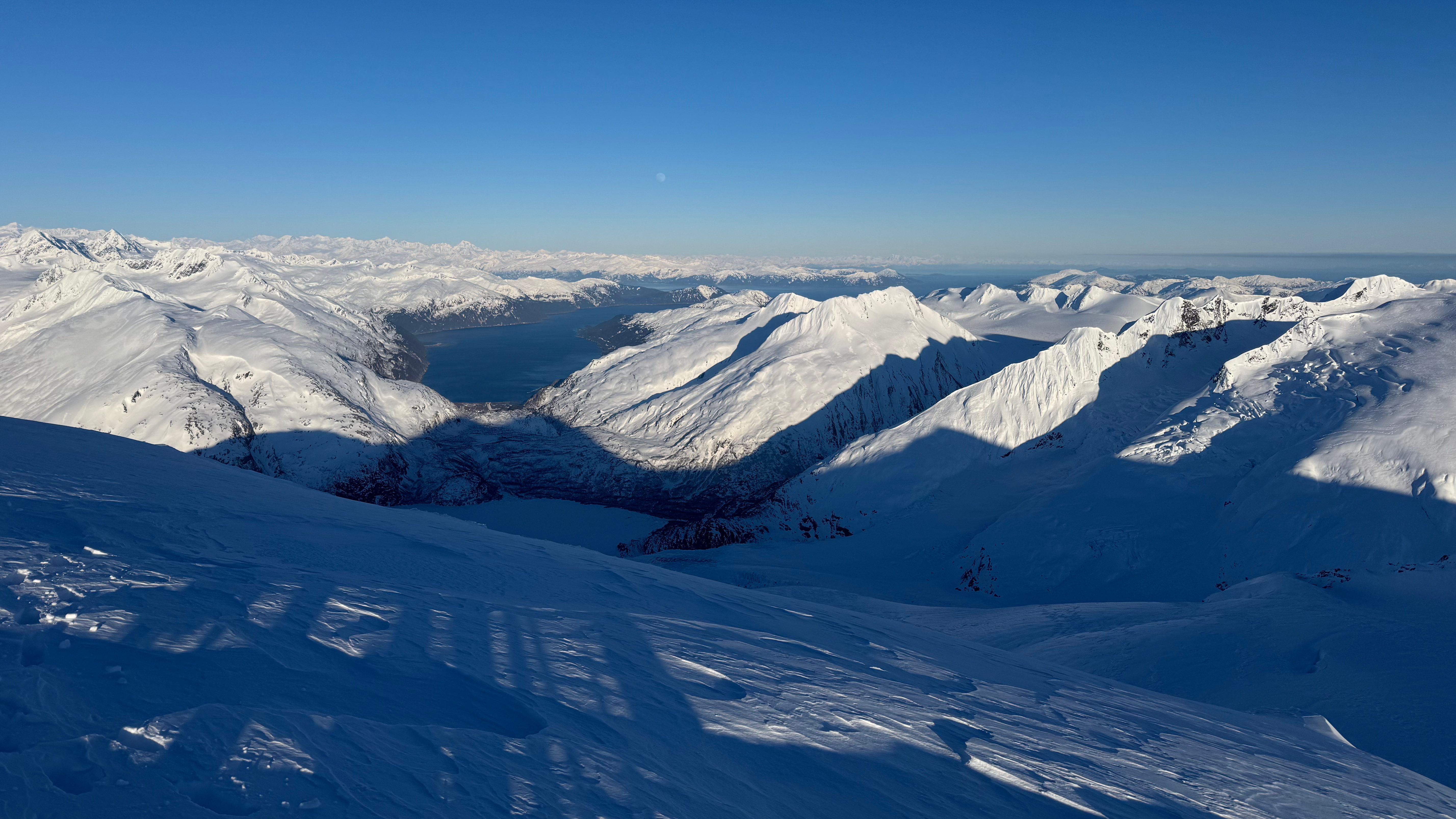
Passage Canal, Bard, and the Three Wise Men viewed from Byron’s west peak
Despite basking in the golden sunlight, the cold air proved more powerful. Having forgotten my phone in the car, I elected to begin skiing while the other two captured the views as well as their phone’s cameras could manage. Precisely, I made jump-turns as I rolled over the edge of the peak into the steep east face. Firm, but chalky snow quickly turned into less edgeable rime-ice. Seeing an end to the rime ice not too far beneath, I began to side step down the slope; I was sure to make sure each edge was engaged before moving the next foot. Even though the side-stepping took full composure, I did have the time to take a moment and appreciate that we were on a slope with a clean, crack free runout instead of the mess of being on the main headwall in a sea of unbridged cracks. After around 100 feet of stepping down one edge at a time, I was able to continue skiing to the col.
Aaron and Brian followed behind on the east face, each being as careful as I was. This gave me time to retrieve our rope and prepare a belay into the next pitch. After sidestepping out so much of the east face, I feared descending from the col could present a similar challenge. Once Aaron arrived at the col, I put him on belay and sent him down into the line. Brian and I were both thrilled to hear Aaron report better, more edgeable snow for the entirety of the belay. We packed the rope away and each skied down into the line. I continued onwards to the bottom of the bowl; enjoying a final air over the last bergschrund that left me landing on a single ski. Turns out race bindings don’t love catching air on boilerplate snow, but I was able to ski away just fine on the low-angle bowl. That should have been enough of a warning for me to lock out my toepieces, but I figured I wouldn’t be exerting those forces on my skis again throughout the rest of the descent.
From the base of the bowl, we navigated back through the icefall, having more fun on the way down than the way up, and then we grouped up before the long, connecting slope to the next icefall. Large, rock-hard pieces of sastrugi characterized the endless slope that Aaron opened up for us. Having almost no concerns about avalanches and larger concerns with making it back to the car before the sun set and temperature fell, Brian and I skied the slope together. I followed five to ten feet behind him, so if I cut off any big sastrugi chunks they wouldn’t have any time to gain enough speed to affect his skiing. This worked well for me as the second, but Brian could not shut up about how bad the skiing was. Eventually, he pulled over and let me ski in front of him. Before I could recalibrate the aggression of my skiing from the lovely, chopped up sastrugi that Brian was providing me to the virgin sastrugi of the untouched slope, I found myself prereleasing from my right ski.
I began tumbling down the slope, searching for snow with my whippet. Three somersaults later I found my whippet in the snow, but before I could stop my left ski blew off and I was back to ragdolling. Another three somersaults and I found my feet downhill with chest to the snow. Everything happened fast, but I knew if I didn’t stop then I wasn’t going to stop before the bottom of the slope. I kicked my bare ski boots into the impenetrable snow and sunk my whippet into whatever I could find. I felt the leashes on my skis stretch, and then bounce back towards me before settling to a stop, a sign I had brought myself to a stop. I took a moment to assess myself before looking uphill at Brian, jaw on the floor as he watched his partner go tumbling down the mountain. I next looked downhill; Aaron was adjusting his boots and totally missed the whole ordeal. The dichotomy of their reactions felt representative of the dichotomy in the snow quality I found skiing second compared to first.
I stepped back into my skis and took a brief moment before focusing back on the mission at hand, getting off the mountain before sunset. I skied down to Aaron with Brian following nearby, and we soon descended into the lower section of ice. A tight choke necessitated a few side steps before finding our flow again. Beneath the exposed ice, we had a straightforward exit in front of us. We followed our skin track out until we ran out of elevation, and then applied skins to get us beyond the last flat bit of trail. We arrived at the car nine cold hours after we had departed, relieved to be back to heated leather seats. A quiet ride back to Anchorage spoke to the effort we had put in, both physically and mentally.
A keen reader may point out that Byron’s east peak is the true summit of the massif; however, as a skier through and through, I find myself caring less about these semantics as each year passes by. Byron’s west peak delivers the most aesthetic and enjoyable skiing on the massif, while the east peak offers nothing more than a few feet extra of elevation. I used to seek the summit of peaks just to say that I stood on top of them, but after countless summits leaving me with no fulfillment, I have begun actively avoiding the extra effort in bagging peaks. I find that my glory in the mountains comes from skiing the best line off of a mountain. If that is off of the true summit, I’ll find my way to the top, but oftentimes, heading to the summit requires leaving the skis behind, or even worse, taking the skis to the top and losing out on a clean fall-line. Byron was a great example of this; to head to the true summit would have meant missing out on the dream ski line.
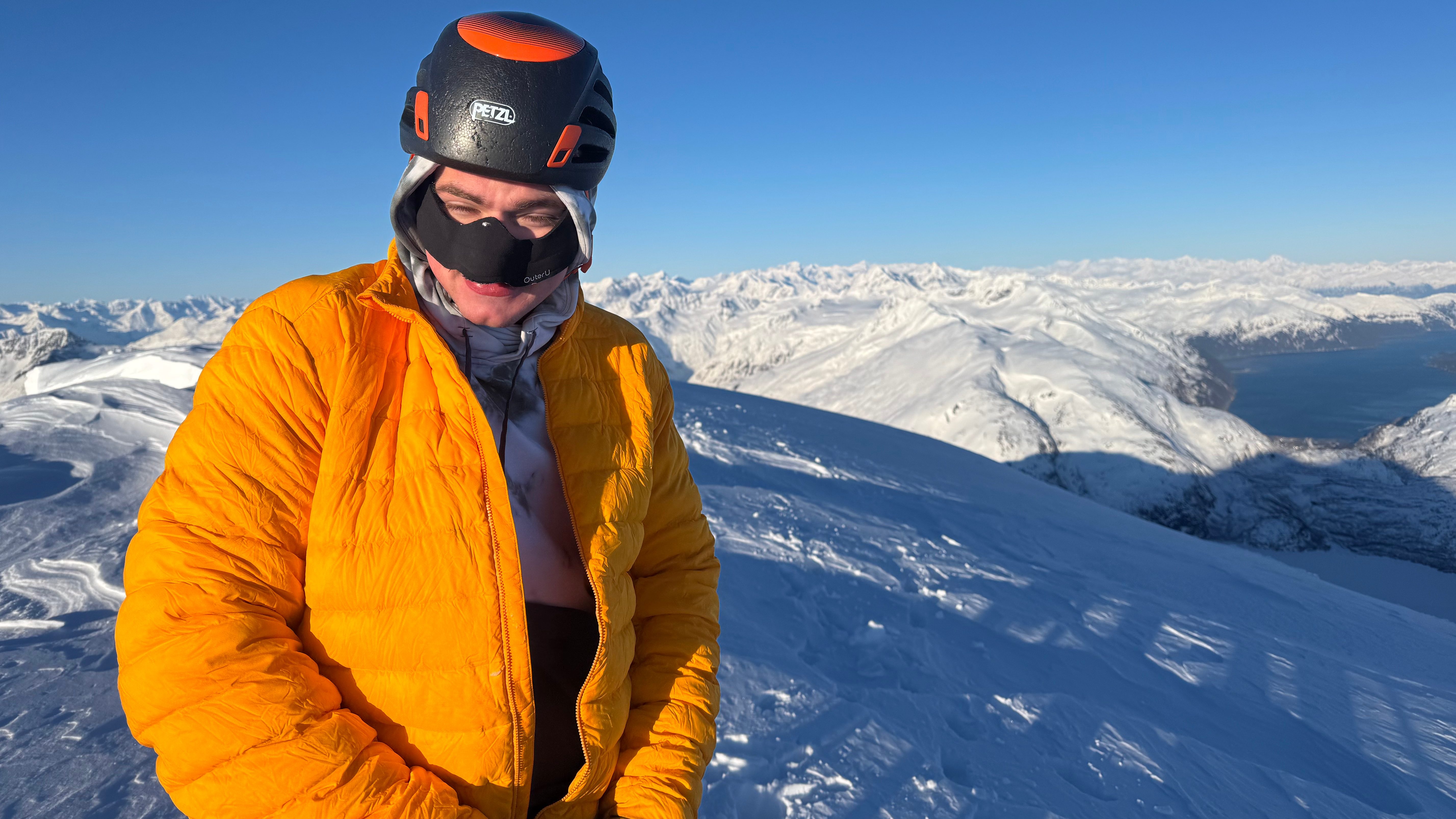
Made it this far? Enjoy Aaron looking very cold on top of Byron’s east peak
2/8/25
After a few days of good skiing on Tincan Proper and Eddies, the green lights persisted even if the snow quality was deteriorating due to powder being blown off of desirable faces. I had heard rumors that the big lines in Girdwood were skiing rather poorly due to firm and sometimes hardly edgeable snow. These reports seemed to be coming from open faces where it was easy for wind to scour the runs, so when a clearing in the skies above Portage showed up on the weather forecasts, I figured it would be a good time to try and ski Byron peak. With steep valley walls surrounding the peak, I hoped we could find good snow everywhere but ridge tops. Skiing off of the peak was a pipe dream knowing the conditions that existed nearby, but you don’t know if you don’t go.
When I called up Brian to rope him into the plan, he was immediately interested and hopeful that we’d ski off the peak, even after reading Mike Records’s trip report where he describes skiing the headwall in firm conditions as “sliding over the edge of a bowling ball.” I’ve found an ambitious Brian to be one of the most valuable partners I’ve had in the mountains. He wants to push to achieve our goals, but never gets too caught up with summit fever. When the mountains are talking, he listens, but when it makes sense to keep moving, he makes sure we are doing just that.
As we drove into Portage, we found that we were not the only group gunning for an early morning, just the only group silly enough to be skiing on such a beautiful day; nearly everyone else was partaking in their yearly pilgrimage to skate Portage Lake. In the Byron Glacier parking lot, we had to negotiate with a moose who had decided the lot was a good place to sleep, but after shooing the majestic giant away, we were out of the car and to the trail. The trail to the toe of the permanent snowfield was fast, but once we reached the dying remnants of the glacier progress came to a crawl.
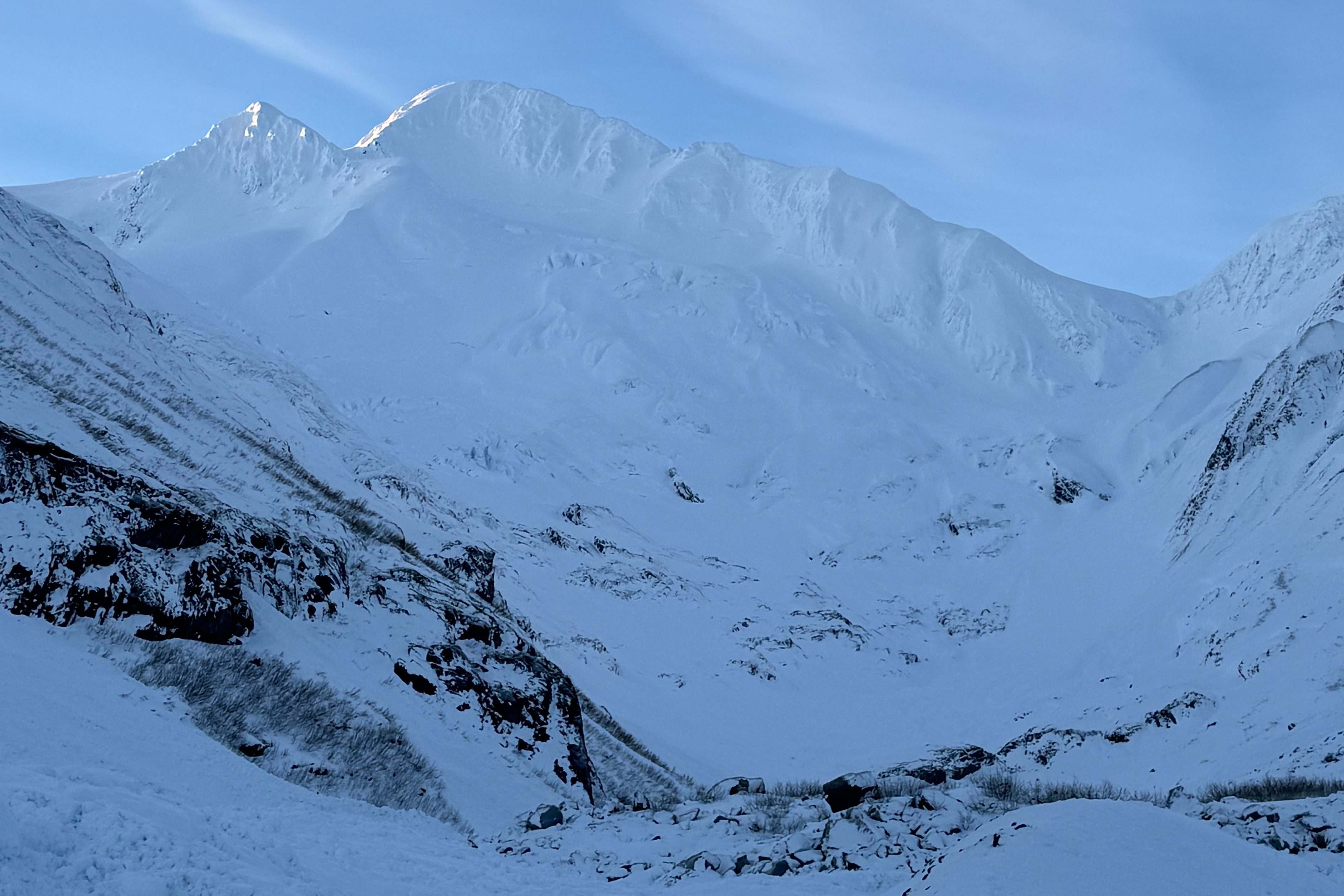
Where the permanent snow field lives in the summertime, we found nonstop avalanche debris. In a valley so tight and with such steep walls, it wasn’t a surprise to see so much debris, but the two of us had underestimated how much it would slow us down. Instead of searching for a place to side hill above the debris, we put our noses down and trudged through it; we were slipping and sliding on our skins, constantly focused on keeping our skis out of the frustrating seams between blocks of debris. After a fair bit of effort, we were above the bulk of the debris and to the base of the mountain.
The whole approach was spent observing the two routes to the top so we could make a timely decision when we reached the base of the climb, so by the time we passed the piles of debris we had already chatted through our thought process. The semi-standard route up the mountain involves climbing to a col in the ridge and then following that same ridge to the peak. This climb keeps you out of the way of looming cornices and rather puts you on top of them. Even with a notable account of a climber breaking off a cornice and plummeting to their demise, this route is the obvious choice when the objective hazards feel a little too much like russian roulette. Luckily for us though, the cornices along the ridge were close to non-existent, and with hopes to ski as of the headwall as possible, we decided we would rather take a direct line up the face of the mountain to allow us to feel out the snow and ditch our skis to continue climbing without them at any point that the snow became too firm to ride. While this line did involve more complicated glacial navigation and the risk of being underneath a massive headwall for some time, the stability and lack of cornicing informed our decision to boot up the face.
As we approached the first icefall, I could not help but be in disbelief. We were an hour outside of Anchorage and navigating what felt like big-mountain terrain. I wonder how many people move to Denver expecting to have access similar to ours…
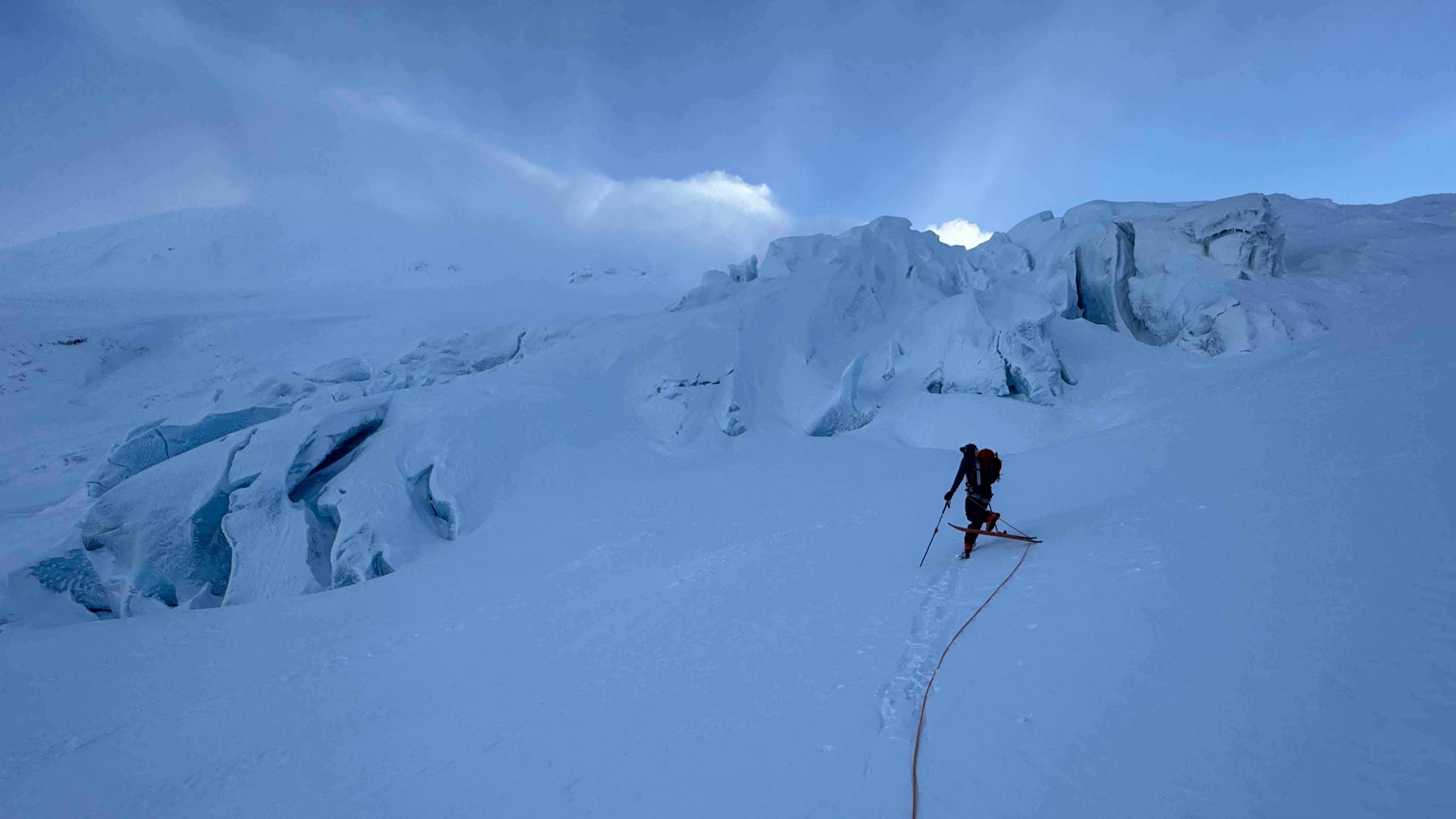
The lower icefall with clouds rolling in from the ocean
The first icefall came down a slope with a tongue that petered out on either side, and where the climber’s right side of the tongue contacted the rocky slope adjacent to it there seemed to be a solid ramp of ice. It’s hard to say if there were big cracks deep beneath us, but to me it felt like we might have been walking up a freshly deglaciated corner system with the icefall trending the other direction. One way or the other, we booted our way up the weakness in the icefall without trouble and enjoyed the presence of the towers of blue ice that observed our every step up their shoulder.
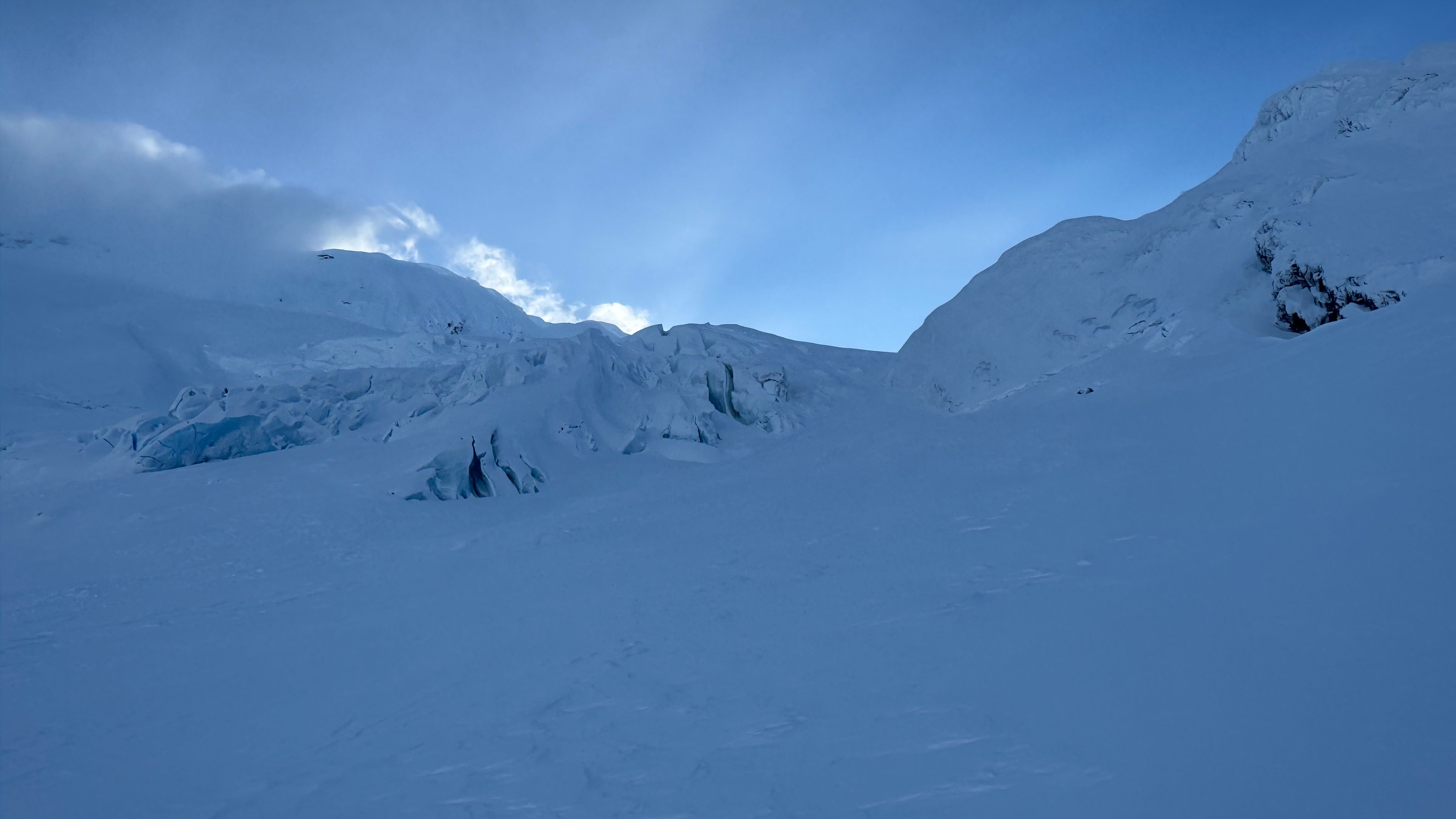
The corner weakness we utilized to ascend the icefall
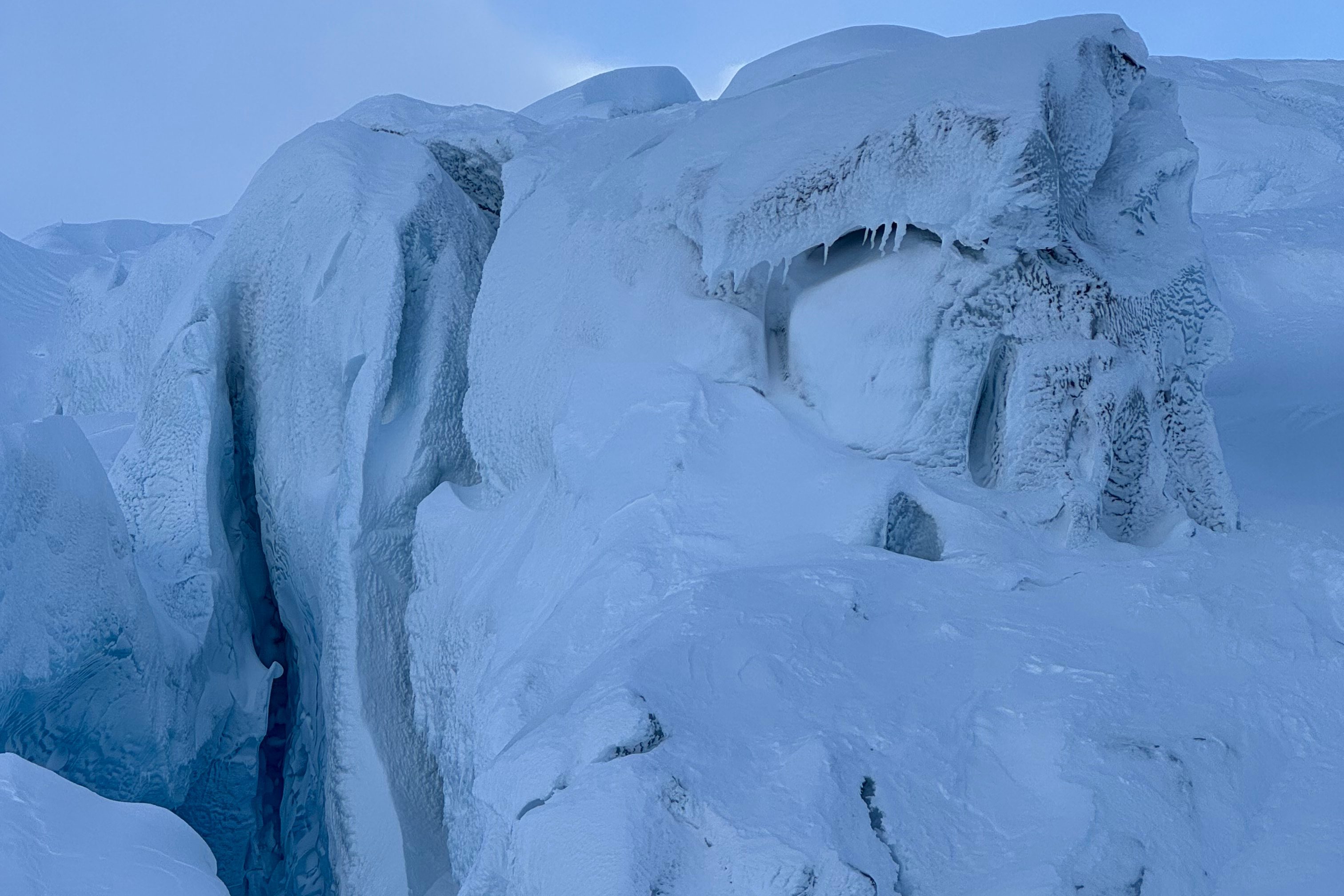
Beautiful cracked ice
At the top of the lower icefall, we left our skis on our backs and continued booting up the increasingly firm snow. Looking down-valley we saw sun illuminating the hundreds of ice skaters on Portage Lake, but thick and turbulent clouds shrouded us in. I had to wonder if anyone saw us up there having a far different experience than those on the lake.
After a bit more walking we found ourselves navigating the first crevasses of the second icefall, but the brunt of it still remained above us. We decided that before we tackle the likely crux of the climb we would take a break, so we found a spot between two crevasses and enjoyed our snacks as the clouds continued to move in around us. The conditions were deteriorating quickly and we agreed if it got much worse we would turn around.
By the time we were finishing out break, the top of the peak was being consumed by the fast moving clouds, but we continued onward, hoping the clouds would roll through. Within a minute of starting off, Brian made an announcement to me that we in fact had not parked underneath a crevasse but rather a large glide crack. With that knowledge, we examined some summer photos and realized we were on a slab that had recently lost all of it’s permanent ice and came to the conclusion that all of the cracks around us were not crevasses but instead glide cracks. Between the clouds moving in and the objective hazards of moving up a slope riddled with glide cracks just waiting for their moment to go, we decided it was time to turn around.
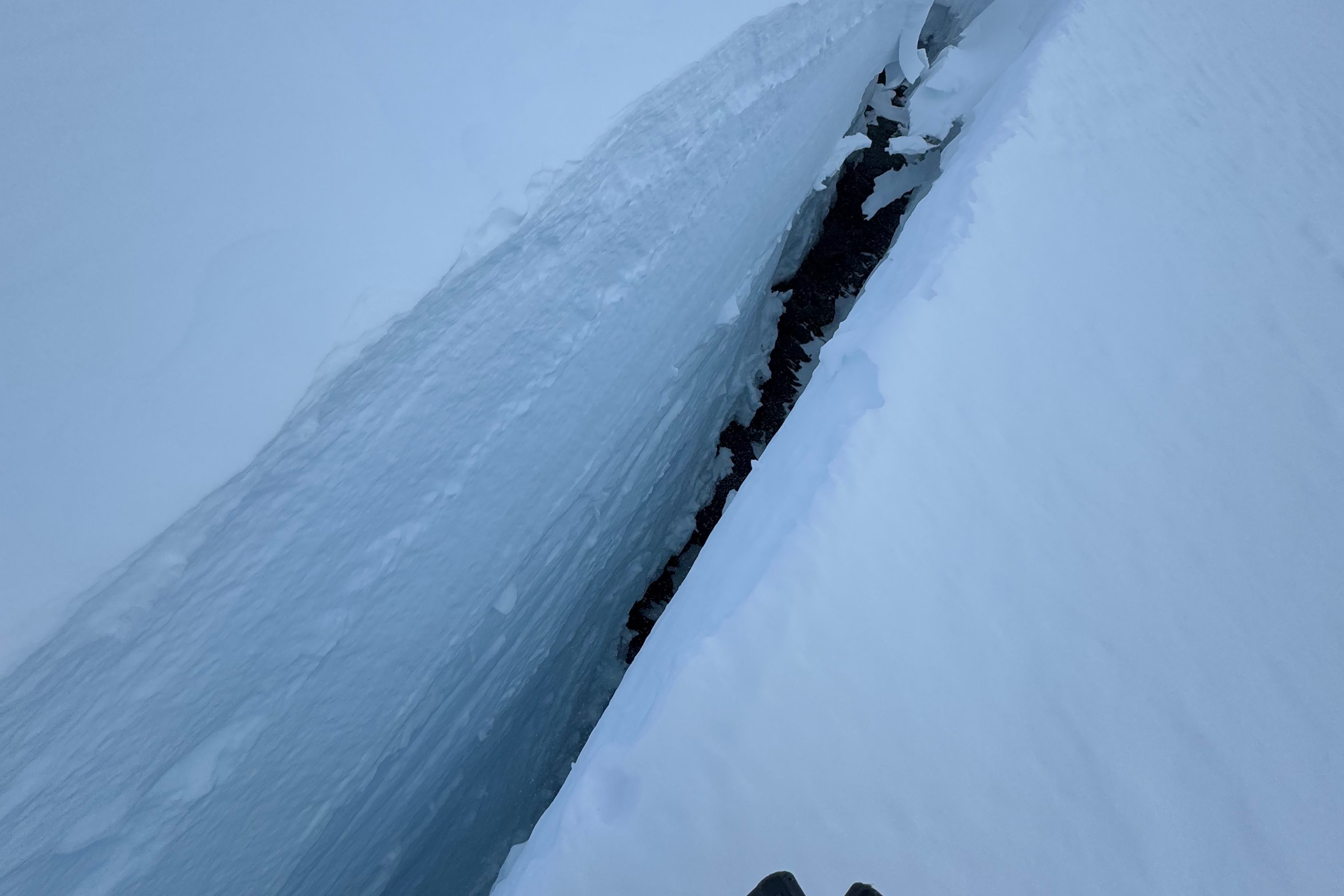
Feeling comfortable with the descent, we packed the rope away and ripped our skins. While touring up the firm snow was a delight, we both knew skiing it wasnt going to be the most fun ski of the season. Brian took off towards the top of the lower icefall first and managed to find a few inches of ski penetration. I followed and found myself skiing with a smile on my face knowing we made the right call in turning around. From the top of the icefall, I watched Brian descend the corridor we had climbed, going from skiing firm but edgeable snow to exposed glacier ice. For how challenging the skiing was, he made it look like a cake walk.
I skied behind him, and the moment one of my 125mm underfoot ski hit the blue ice, it decided to prerelease and go running down the ice fall. In retrospect, taking out a brand new setup on such an adventurous day was a questionable call, particularly when the dins were previously set for a much narrower ski. Luckily, the corridor wasn’t too steep so I was able to easily side slip my way through the ice sections and connect turns on one ski when the snow was decent. One of the benefits of such fat skis is when you lose one, you can still get powder turns on the other. After a few joyful single-ski turns, I reunited with my lost ski and got ready for the rest of the descent.
If we continued to ski the fall-line we would lead ourselves into the debris-filled valley floor, so instead we began to traverse the skiers left side of the valley. We traveled over a few slide paths, but it was far easier to make it over the paths high on the side of the slope instead of where the debris piled up down lower. Once we had gotten ourselves within range of the well-used trail, we descended to the valley floor and carried our speed all the way back to the car. From the car, we could see the the Bryon valley was the only drainage in all of Portage to capture any clouds.
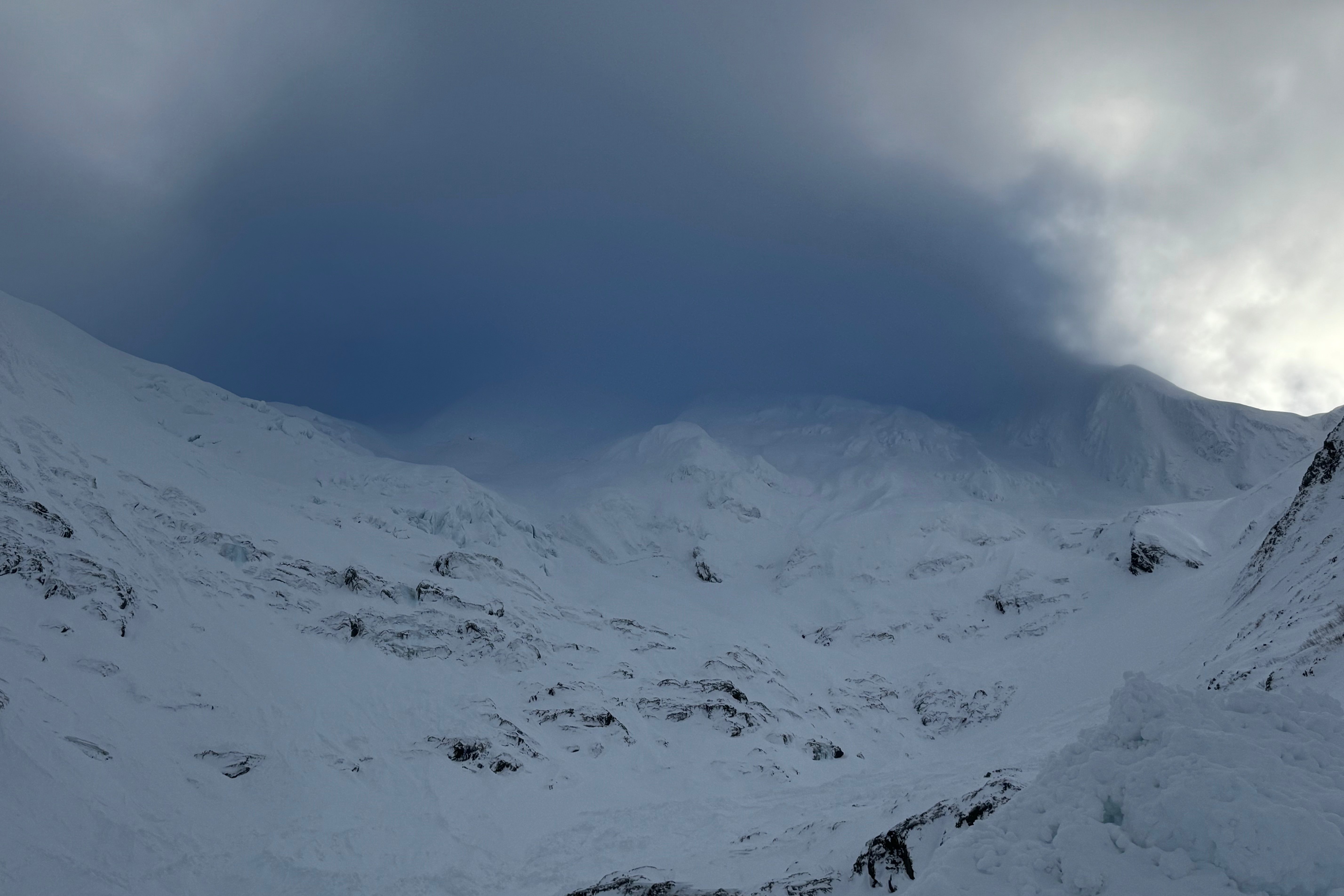
Each trip into the Chugach, I find myself leaving with a deeper appreciation and understanding of the mountains that I have the privilege of calling home. Portage is an ephemeral land of tight weather windows and quickly-changing conditions. While I wish the clouds could have waited a few hours to roll in, I am happy to have gotten on the mountain and given it an honest attempt. Having to turn around can be tough in the mountains, but making it home safely is all the feedback I need to know we made the correct decision. We learned a lot about the area and feel more prepared for our next try at the beautiful, backyard ski mountaineering objective.


Leave a Reply