To many, the quiet town of Willow is nothing more than a reminder that you are through all of the city traffic until you reach Fairbanks, but to paddlers the town hosts one of the premier whitewater opportunities within the state. The creek that bears the same name as the town has earned a reputation as some of the best skill-building water within South-Central Alaska with opportunities to paddle class II all the way up to class V water among its four distinct sections.
Upper Upper Willow Creek (III)
I have not paddled this section, so expect better beta after I explore it.
When the water is too high to comfortably paddle the more popular stretches of Willow Creek, the upper reaches of the creek still offer an opportunity to enjoy the river. Between Grubstake Road and North Star Bible Camp exists continuous class II and III rapids. While none of the rapids are particularly notable, there is a chance that wood and other strainers become a problem due to the old mining history of the area.
Upper Willow Creek (V)
I have not paddled this section, so expect better beta after I explore it.
Upper Willow is where the hardcore boaters can go to cut their teeth. This stretch descends through the upper canyon, where the river is choked into class IV and V rapids. Josh Peterson has a good write-up on his blog about this stretch.
Guardrail (IV-)
Guardrail and the following stretch, Red Gate, are the two most popular sections of Willow Creek, and for good reason. Guardrail is generally paddled above 450cfs, but expect a very boney run at those flows. On the upper end, a skilled boater could navigate down Guardrail above 1500cfs, but us packrafters tend to draw the line closer to 1000cfs as eddies and recovery zones wash out completely at higher water.
Guardrail begins with a short hike marked by a red painted section of the guardrail on the Willow Road. The hike puts you at the end of the upper canyon, allowing an eager boater to hike up for the last few stout class 4 drops of the upper canyon. Due to the stacked nature of the rapids in this section of river, most elect to launch from the small pool that the trail takes you to.
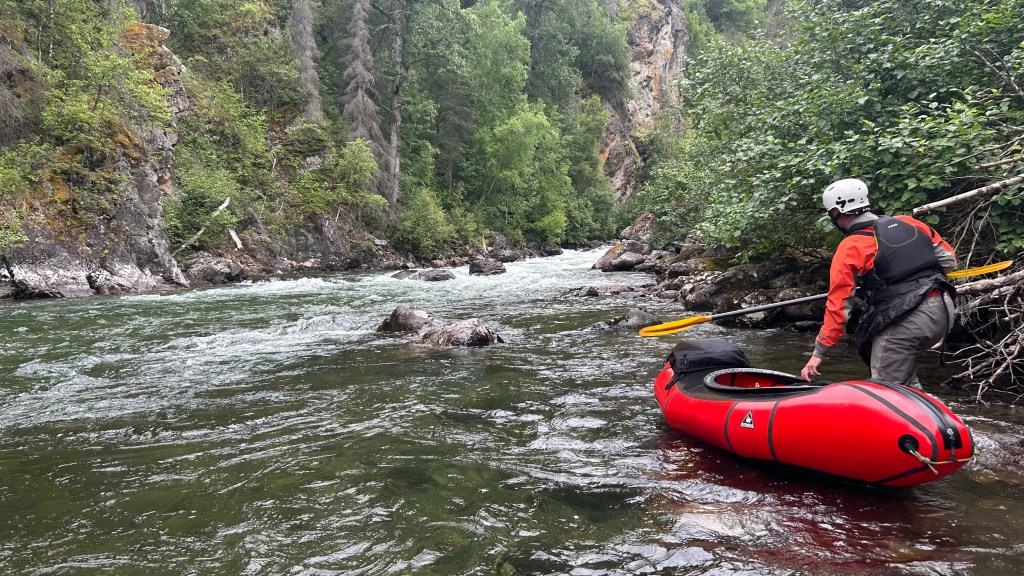
The rapid beneath the pool that serves as the put-in is called Warmup Rapid (IV) and it serves as a solid litmus test for the remainder of the run. Beneath Warmup Rapid is a good recovery pool at most flows, but at high-water, this pool can wash out. Below this pool are two more drops called Drop 2 and Drop 3; each of these are straightforward. The next two miles include frequent pool-drop rapids, most of which allow for clean recovery zones, but a few end up stacking together at higher flows. Many of the rapids are unnamed, but the biggest rapids all have names. These include Left and Then Left (III), Left Chute (III), Right Chute (III) House Rapid (IV), 180 (III), Yellow Brick Road (IV-), and Five Fingers (IV). House Rapid is easily recognized by the large house on a bluff rising over the left side of the river. Five Fingers can be hard to recognize while on the water, but consists of five ledge drops that require constant paddling to punch through. If you’re following someone else, Five Fingers is rather easy to identify, just watch for your partner to disappear behind the horizon line once and then prepare to watch them disappear four more times.
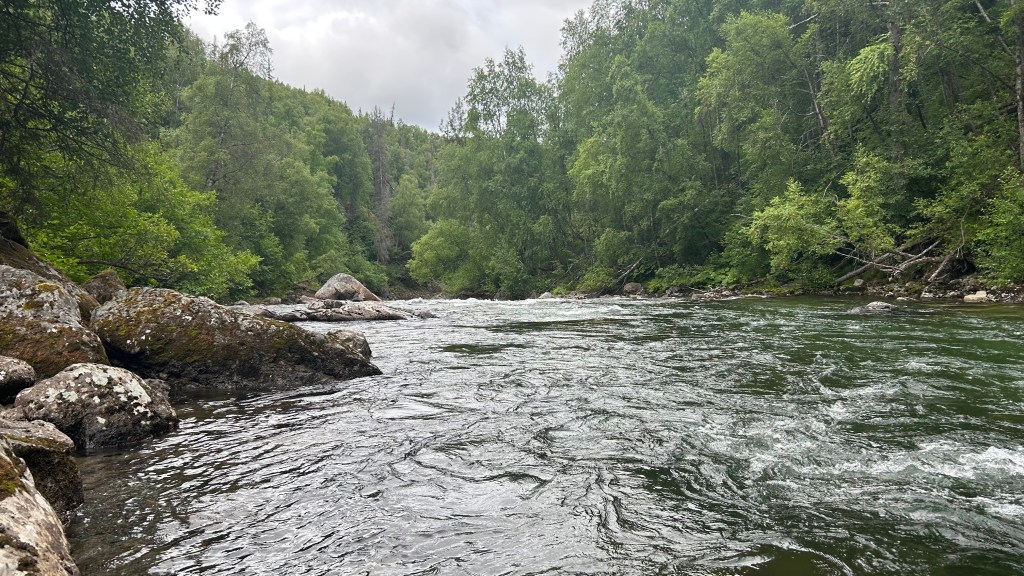
The pool beneath Five Fingers marks the end of the harder whitewater and the put-in for Red Gate.
Red Gate (II+/III-)
As you drive up the Willow-Fishhook Road, you will pass Susitna Sled and Kayak where you can buy a key to access the Red Gate put-in. You can either pay $10 for a day pass or $40 for a season pass for the access. From the shop, continue about a mile up the road until you see a red gate which may be open or closed. Regardless if it is open or not, you should still pay the fee as the access is granted through private property owned by Alaskan legend Art Davidson who strives to keep the river in pristine condition. Be sure to return the gate to the position you found it after passing through.
Red Gate is a great option for the aspiring class III boater. There are sections where the river is wide and mellow, and there are sections where there are real drops that require composure to avoid flipping. In the case of a swim, Red Gate tends to be rather forgiving as long as there is enough water flowing to avoid getting banged around.
The biggest rapid on this stretch is the first rapid, Splashies (III-). Generally many lines exist, but if one is feeling hesitant you can elect to walk around this rapid. Beyond this rapid there are two other class III features but most choose read-and-run beyond Splashies as the other rapids all are small in length and provide ample recovery opportunities.
The take-out for Red Gate is the Shirley Town bridge. As you approach the takeout, expect to see the density of fishermen increase; be sure to stay aware and respect their lines. As much as us boaters can feel like we’re the coolest cats on the river, we should strive to share the resource with all disciplines of water-people. I personally believe fly-fishing is a great way to appreciate the places we love to float so much as well as an opportunity to study hydrology with a different lens.
7/12
700cfs (Willow Creek near Willow)
With flows in the Goldilocks zone, Jake and I headed up Guardrail on Willow Creek for my first paddle down the stretch. He did a great job prepping me for the float, so by the time we got to the water we were already chatting about hiking up for an extra drop or two. After looking at the first drop above Warm-Up, we chose to not run anything higher due to the small size of the pool above Warm-Up. We scouted many of the rapids, and made it through Guardrail without incident. We ran Warm-Up center the entire way, and we found wood at the first braid in the left channel as well as on the right of a tongue above House Rapid.
 Kip Sprout
Leave a comment