8/16/25
Being in Anchorage has pushed me to become more involved in the sports and lifestyles that I align closest with; this means I have been doing my best to make it to every Mountaineering Club of Alaska event, every packrafting meetup, and each little event in between. While the climbing and skiing communities of Anchorage feel well-established, the packrafting community feels newer and younger with less recurring events and meet-up opportunities, so when I heard that there were folk in the Denali area putting together a race mid-summer, I knew I had to be involved. Initially, I was struggling to find a partner to paddle the Gnarnana 50 with me, so I had anticipated running sweep as a part of a safety crew, but at the last moment Olga’s schedule cleared and she elected to join me for the race.
After work on Friday, we loaded up into my van and began heading north to the venue of the race. After checking in and finding a place to sleep for the evening, we began speaking about race logistics. The race navigated 50 miles of the Nenana River, beginning across from Wells Creek off of the Denali Highway and ending at the commercial launching site for the canyon section through Denali Village. The 50 miles ended up being broken up into two distinct sections, the upper 22 miles being very mellow class 1 to 2 riffles, with the lower 28 miles consisting of more challenging class 2 to 3 whitewater with a big water nature. Knowing it was going to be a long day on the water and that Olga and I aren’t the most competitive, I suggested that we try to conserve energy in the flat water by limiting our paddling and not working too hard too early in the day. After agreeing to our plans and double checking our gear, the two of us slipped into a chilly slumber for the evening.
We awoke early in the morning to even chillier weather than we had fallen asleep to. Not only was the air temperature lower, the winds had also increased. The trees and bushes danced around in the gusting winds; each time they bent over revealed a clue as to how the day was going to go. We watched closer, and it became apparent that, at least to begin the day, we would be paddling directly into the wind. We then meandered down to the put-in where other astute boaters had made the same realization as us. After introductions and safety briefings, we were ready to begin the race which had a staggered start.
We launched in the middle of the pack, late enough to watch those in front of us struggle to maintain momentum without paddling. As we pushed off, we were immediately met by a consistent head wind with gusts doing their best to blow us off course. We reluctantly paddled the flatwater section with much more effort than we intended to be paddling with, but quickly found ourselves being passed by more motivated groups. The river was gorgeous, but uneventful throughout this section. It reminded me of the Kenai River in many aspects with it’s braided but mature nature; the islands created by the braids were not the same gravel bars you see high on glacially fed rivers, they were full of trees and bushes which displayed a level of order you don’t find on the youngest of rivers.
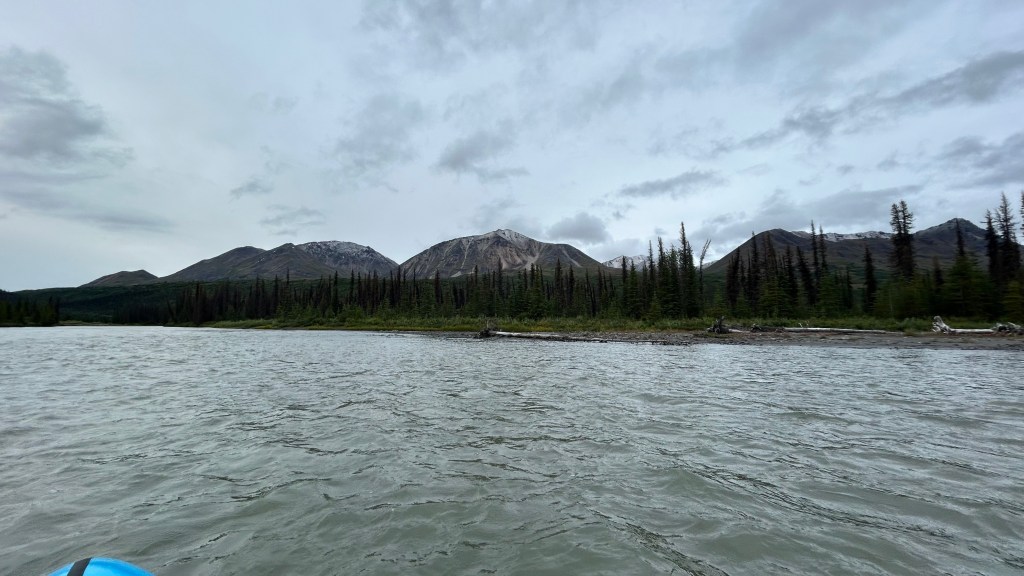
As we continued downstream we passed through the Reindeer Hills. This is the point where the river veers furthest from the road, meaning we would not want to bail throughout this stretch. While the hike disincentivized bailing, the increasing headwinds and more frequent gusting was giving us reason to consider pulling the plug early. Knowing there was a checkpoint not far beyond, we continued pushing with the tough conversation of bailing in the back of both of our heads. As we neared the bridge near the confluence of the Jack and the Nenana, the winds reached a violent level. All that could be done was to watch the gusts come screaming on top of the water and brace for an impact. Similar to running whitewater, each gust required you to tee-up to it in order to avoid the threat of flipping.

Olga and I exited our boats at the bridge and began talking about if we should continue or not. Some of the race organizers told us they expected this to be the worst stretch, and when combined with the fact that we would parallel the road for the rest of the day, we elected to continue until we could no longer beat the fight against the wind. Just as we were making our decision, a team was approaching behind us;. They were about to go through the same decision-making process as us, but before they could begin chatting, a gust flipped one of the boaters, proving the sheer power of the winds we were in the midst of.
As we launched from under the bridge, we planted our paddles and held on to the current underneath our boats. Between gusts we would paddle to make downstream progress before planting a paddle and bracing through another gust. We continued this pattern, crawling downstream at a snailish pace. Bushes and trees on the shore provided some reprieve from the winds, but there was no good solution other than escaping the wind tunnel made by the peaks around us. After at least an hour of hard paddling, we began to feel the winds settle down. At the same point, we encroached on the first class 3 rapid in the race, Panorama Rapid. The rapid itself was straightforward at the medium-low water levels we were floating, but at higher water I imagine it is a splashy, fun couple of bends. The real joy of the rapid was in the fact that the river was now channelized and flowing at a much faster clip than before, allowing us more assistance in pushing through the head winds.
The river remained calm after Panorama without any notable rapids for another long stretch. Even with the increased water speed, we still found ourselves hunting for shelter by allowing for the foliage to break some of the wind for us. With this in mind, a small back channel lured us in. Big cottonwoods on either side of the channel broke the winds. At one point in the backchannel, a deep rumble began approaching from the skies around us. Since we were in such a tight channel with trees lining the banks, it wasn’t until four helicopters fully equipped for war blazed over our heads, nearly giving us a haircut. The same helicopters had been used by President Trump to flex America’s power the day before when he and Vladimir Putin met in Anchorage.
At the end of the channel, Olga and I took a break to stretch our legs; this allowed another group of 3 boaters to catch up with us. As we all chatted about the woes of the morning, we agreed to group up for the remainder of the race. The social relief of having a group of 5 made the time pass much quicker, and the local knowledge of the river they provided also helped reinvigorate the motivation to finish the race. The next hour flew by, and after one more straightforward class 3, we were entering the “Backyard Section” of the Nenana; a stretch our new friends knew very well.
We took a long break at the boat launch that marks the beginning of consistent whitewater for the rest of the day. From the moment we launched, I had a smile glued to my face. A summer in Anchorage meant a lack of big water boating, and the Nenana began to fill the cup quickly. Splashy wavetrains with infinite sneak opportunities were broken up by the occasional muncher hole. Walking the line between fun whitewater and avoiding a swim on such a long day became the name of the game. While every wave in this stretch could be avoided, there would be no fun in that.
Each mile behind us was one less in front of us, and the locals we were now paddling with were sure to keep us in the loop with how much longer we had. I was jealous how well they knew this water, it must be so much fun to have the Nenana be your local run. After each set of waves, they’d tell us with pinpoint precision how long it would be until the next rapid. As we began approaching the take-out, the whitewater was at its pinnacle, but having done the canyon in a raft a few summers prior, I was keenly aware of what lay below our finish line. With Denali Village coming into view, I knew the end was near. We navigated the last rapid, Terror Corner, and after a few more wave trains we were pulling into a packed finish line. Most of the other groups were waiting there for us as Olga and I managed to be in the last group on the water and also the slowest group of the day. Fortunately, finishing was our goal, not winning, so we were happy to have reached the end in spectacular style.
After the race, we got a shuttle back to our cars at the put-in. The shuttle involved multiple opportunities to relax depending on your depressant of choice. I settled for the green option which helped the tales of the river turn out that much funnier. After getting to our car, we retraced our shuttle ride and headed to Panorama Pizza where dinner and a short ceremony took place. After using the last of my energy socializing with the competition, Olga and I began our drive back to Anchorage.
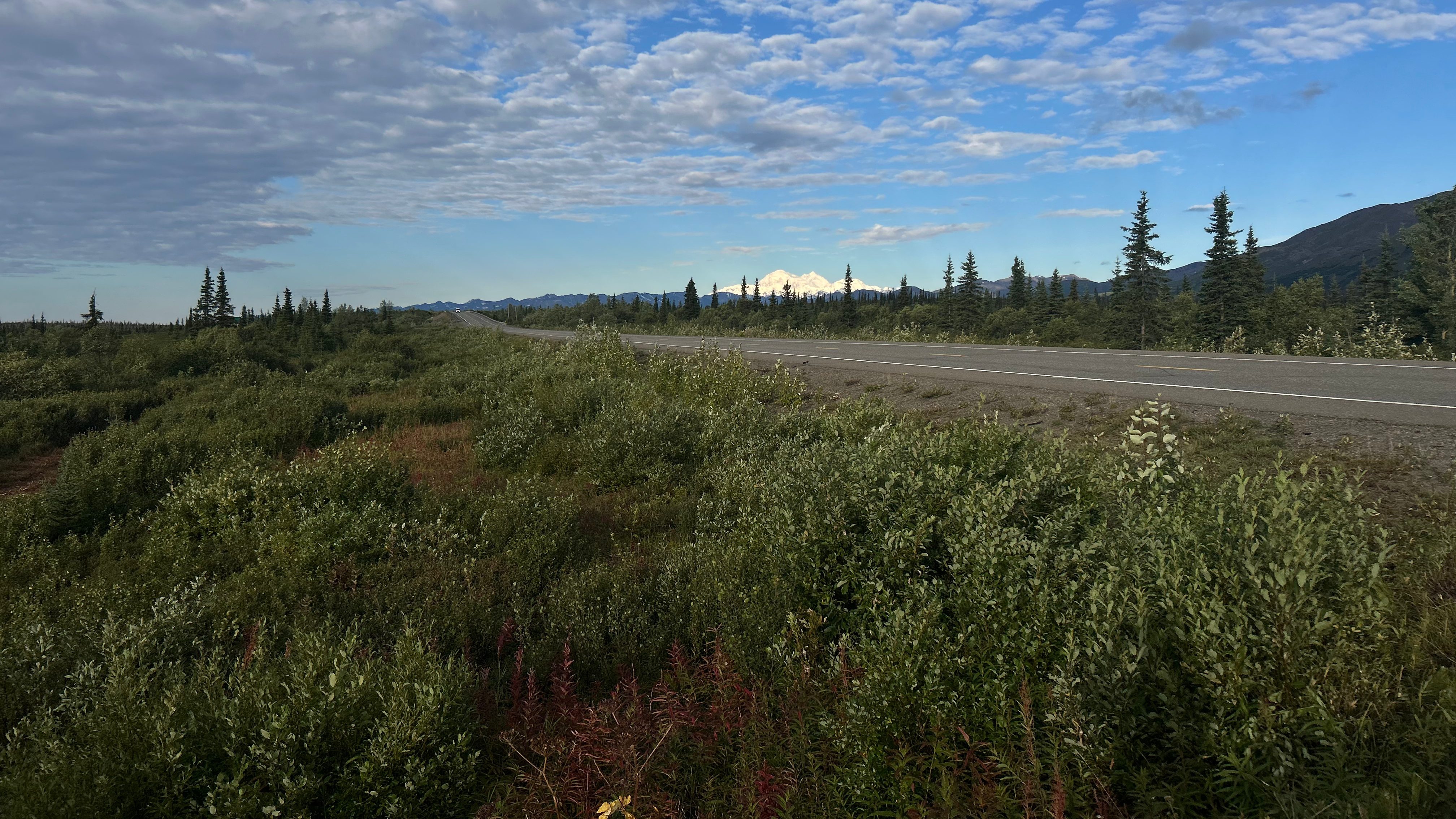
An hour or two of driving in the evening found us at a lovely place to camp for the evening. In the morning we were woken up by a Princess Cruise bus invading our parking spot, but as we arose and exited the car, we saw why. Denali rose above the tundra surrounding us, a beacon of white amongst the beautiful late-summer colors of the Central Alaska Range. That morning we made our way back to Anchorage and settled in for a well-earned lazy Sunday.
Special shout-out to Russ and the rest of the crew who put together this event! I felt honored to be a part of the inaugural run, and I look forward to seeing how the race evolves throughout the years!
 Kip Sprout
Leave a comment