5/5/24-5/12/24
If you spend enough time in south central Alaska skiing, you will eventually hear rumors about a land of mega couloirs that lives just up valley from the town of Chugiak. Peter’s Creek flows through town, but if one chooses to slog to the headwaters of the same creek they will be treated with an assortment of couloirs; some of these extending over 4,000 feet into the sky. It didn’t take long for this zone to grab my interest, and after hearing a good friend, Brian, talk about wanting to go back there after an unsuccessful attempt the year prior, I knew I had a partner for a spring epic.
The two of us both had some downtime between work in the springtime, so we elected to try to connect upper Peter’s Creek with the Eklutna Traverse via Transcendence Pass. The prize line of the trip was the northwest couloir on Mount Rumble, a 4,500 foot ski that largely holds at 40-45°. In order to achieve this big of a line safely, we built in a few weather days which would allow us to ski the line in the best conditions we could. At the end of our planning, we decided to pack for 10 days with the hopes of making it out earlier than that.
Our entry into upper Peter’s Creek was through Ram Valley, a hanging valley that is currently going through human created access problems. Brian is from Eagle River, and knew a way around any private property, but it involved lots and lots of bushwhacking.
When the day came about, we threw our 80lbs packs on our backs and began the long walk through the woods. Low hanging branches were trying to steal our skis every step, but eventually the brush began to thin out. Soon enough we were in Ram Valley where the city we had just come from became only a memory. To be so close to Anchorage but so isolated is a special feeling, and something I love about the western Chugach.
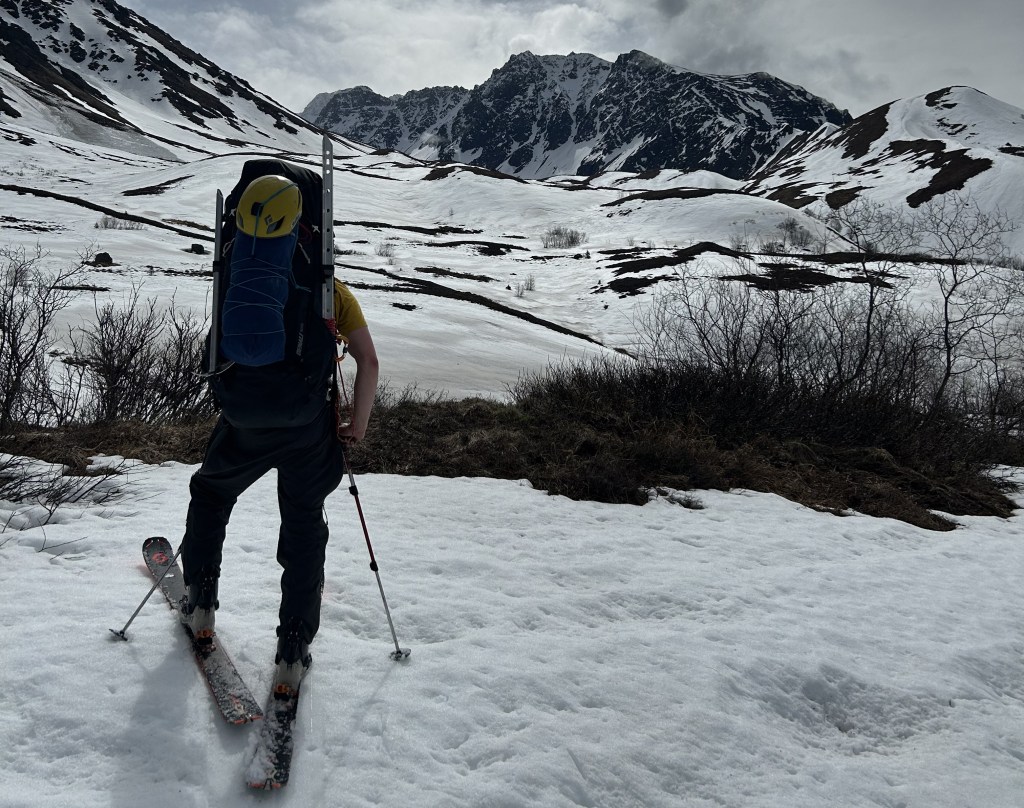
We built camp the first night at the base of the Cumulus Couloir. Our plan was to ski the couloir the next morning, but when we woke to a partially buried tent and a healthy amount of fresh snow, we realized our plans might not be happening. I didn’t wake for it, but Brian mentioned being woken up by an avalanche, so it looked like it was unlikely we’d be skiing until things healed up a bit.
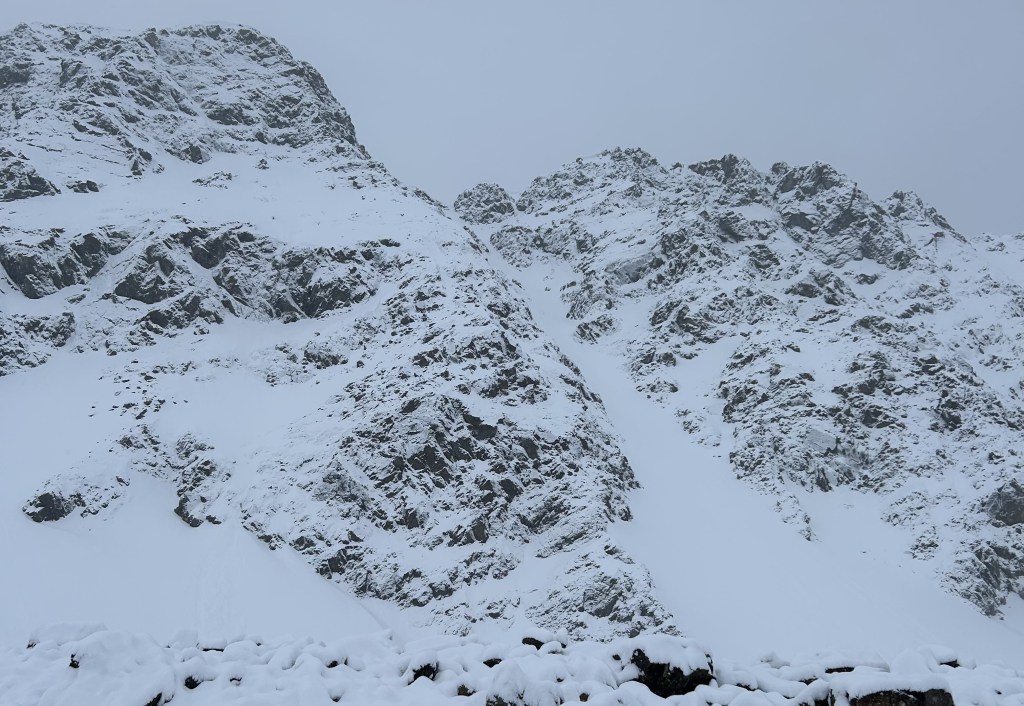
Instead of skiing in Ram Valley, we decided to push over Bombardment Pass and make our way down to Peter’s Creek. We made our way to the pass which we climbed one at a time. At that point, we had watched at least a dozen avalanches, and with old debris flanking our path over the pass, splitting up seemed to be the wise decision. As Brian climbed, I watched two D1s come down from Korohusk, but when I asked if he heard them, he remarked that he was so focused he didn’t hear anything.
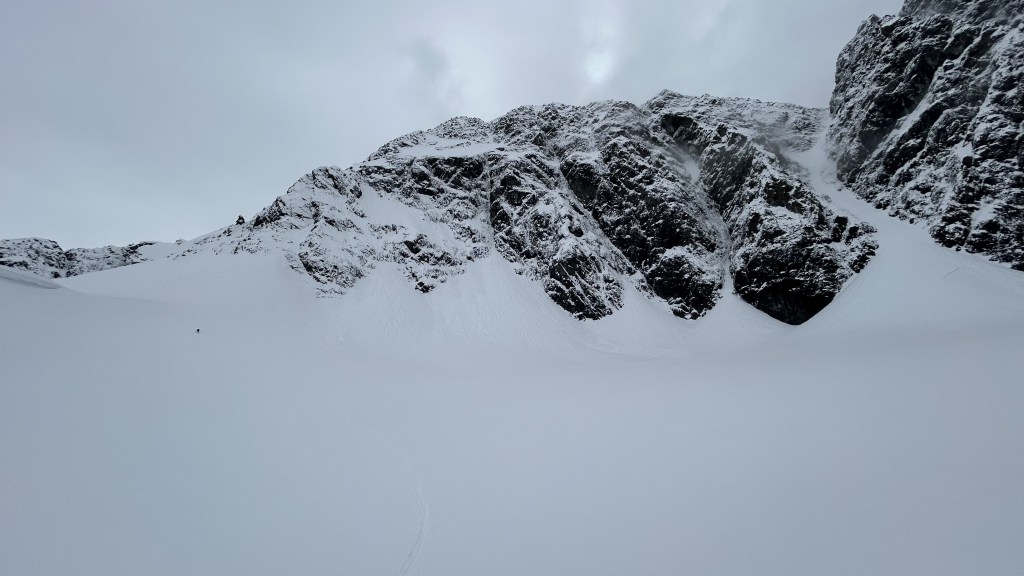
On the back side of the pass, we had to ski through avalanche terrain, so we did what we could to be as safe as possible. Regardless of the margins of safety we gave ourselves and the fresh powder, neither of us were thrilled to be skiing. We quickly punched through the avalanche terrain and found ourselves booting until we reached a lovely low angle slope. We skied this, and continued until we arrived at the descent into Peter’s Creek.
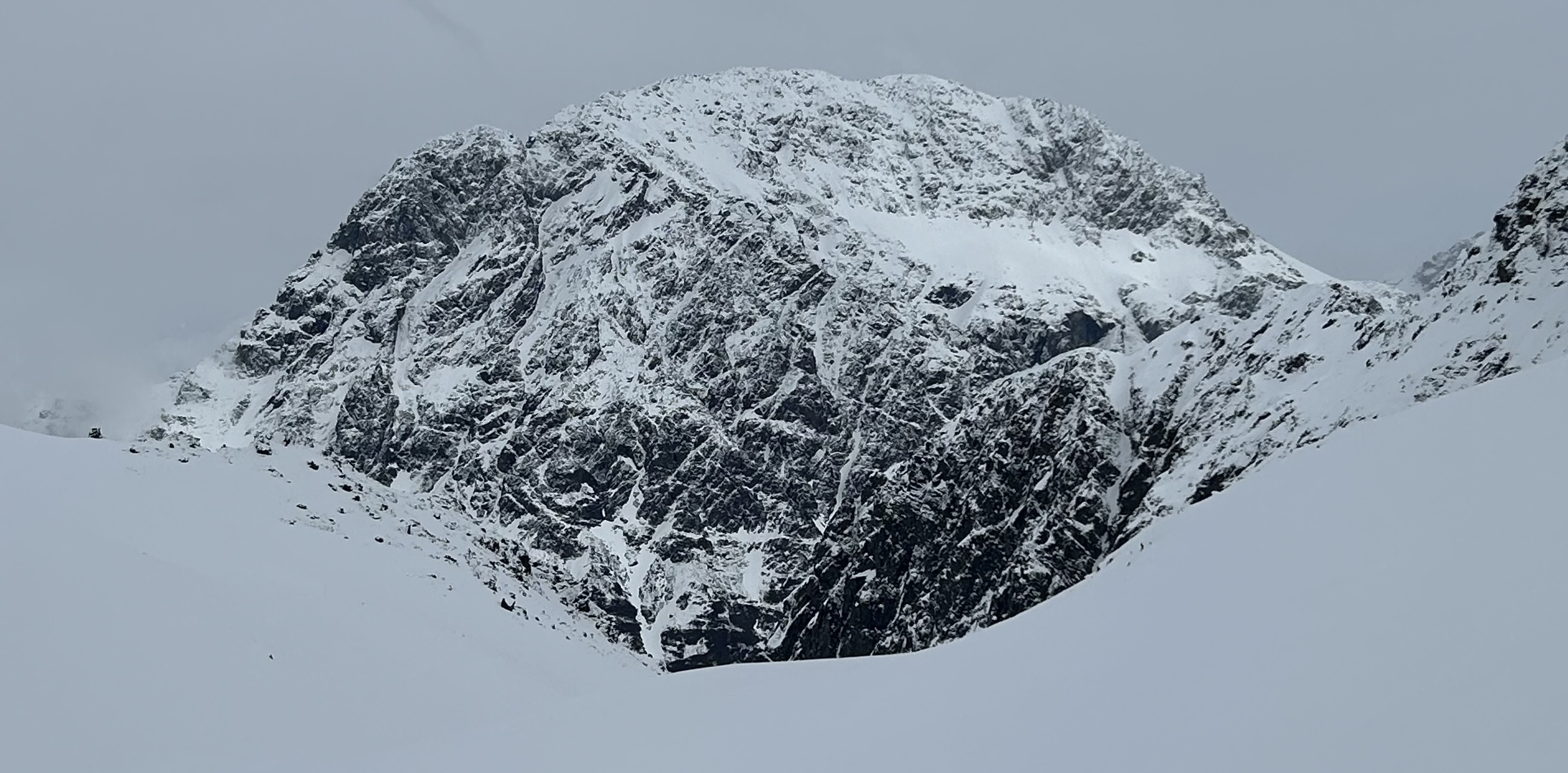
This pitch was steep enough to go, but luckily had not seen new snow due to being at a lower elevation. The snow was patchy, but we scouted out a few patches we could easily link together to make it all the way down to the creek. We began our ski and found some of the worst isothermal snow imaginable, but it beat walking downhill. We slowly picked our way down, pulling into islands of safety occasionally to let our wet looses pass us. Watching the snow gain speed and eventually blow up on the rocks beneath us kept us humble and careful. Towards the bottom, a few fun turns were found in the shade, and we were able to carry our speed right onto the creek where we set up camp for the night.
At camp, we discussed what we saw throughout the day and agreed that our prize line could be off the table, but we wanted to keep our minds open. At this point, we also saw thick clouds sitting over the Eklutna Glacier.
Waking to more clouds over the Eklutna, we elected to take daypacks up to the base of Transcendence Peak to look at the pass and get a decent ski in. We climbed up the scenic pass quickly, but did not see improving conditions on the backside. Better weather was with us on our side of the pass, so we talked about alternative exit plans, but did not set anything in stone. We turned around and skied what we had climbed which led us to a long lunch at our camp. Since we moved so quickly in the morning we had time to look at maps and Brian found an aesthetic ridge that would lead us back to the mouth of Peter’s Creek. After a couple hours of deliberation and watching the weather, we committed to walking out of Peter’s Creek instead of the Eklutna.

After we made this decision, we packed up camp and bumped it down a few miles to set us up in a position to explore Rumble better. That evening, we were treated to amazing views of Rumble, Benign, and the rest of the surrounding mountains. This built up hope in getting into one of the bigger couloirs.
The next morning, we set off with daypacks to touch the Wall Street Glacier and explore the other fork of Peter’s Creek. We spent all day wrapping around Rumble, swapping between skis and boots depending on what the snow gave us. Eventually we found ourselves standing in the amphitheater that the Wall Street creates. It was amazing to be in such big terrain knowing we walked from the road. We had been hoping to see inspiring weather throughout the day, but it never came. We knew we would not be skiing any of the mega lines we were standing at the base of, but we had walked too far to not get any turns in.
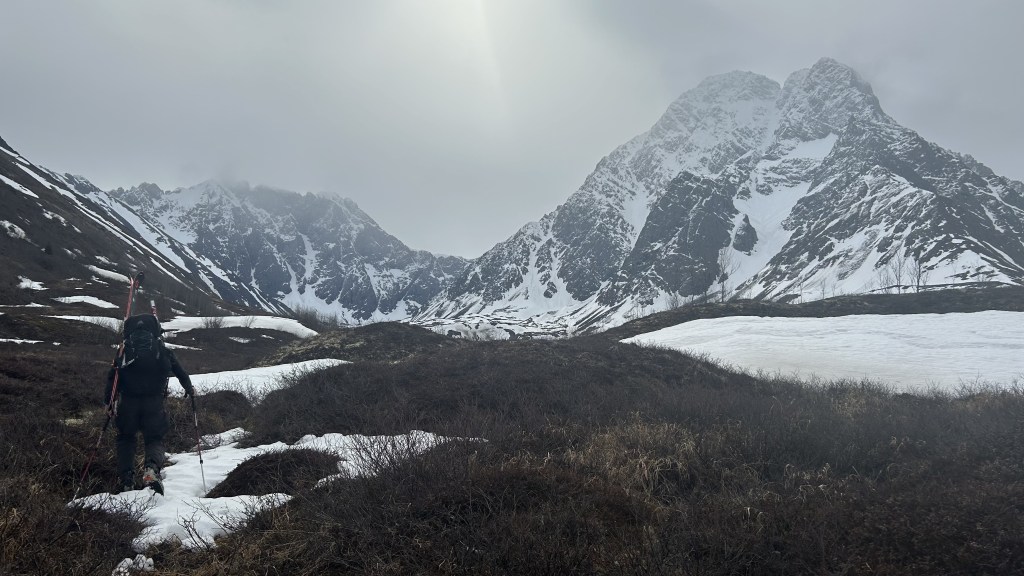

We found a small line on the northeast side of Rumble that looked rather engaging. From bottom to top, it was a curtain of snow that pinched into a couloir. With more snow, it seems that the line would’ve been rather open, but we were restricted by a melting snowpack. We climbed shy of 1,000 feet and decided to transition when we heard rock fall from what seemed to be directly above us. Rumble has a fitting name, the noises that come from it are as scary as anything else. As we were transitioning, we saw an avalanche rip nearby the Malignant Couloir. Soon enough, we were skiing the first pitch of our line. I led out and made some deliberate turns to test the snow. While it didn’t seem slabby, I did send down a wet loose. On the 40+° slope, this quickly picked up speed and ran all the way to the bottom of the slope. I continued my ski knowing what we were dealing with, and soon pulled over under some rocks that would shield us from above. Brian followed, and upon reaching me I gave him the lead on the second pitch. As he skied, I heard rocks tumbling down from above me, which was great on the nerves. Once Brian was settled at the bottom of the slope, I made off and enjoyed the long steep ski. The wet loose problem seemed to subside a bit through here, allowing me to enjoy the ski a bit more. At the bottom we bumped fists and began back to camp. On the way back we got a few more enjoyable turns. Finally, we reached camp and settled in for the night.
Feeling like we had exhausted our locations to find good, safe skiing at the top of the valley, we made our way to the ridge exit the next morning. Our plan was to connect Ah! Bees! Peak to Eklutna Peak. We would spend around 15 miles on the ridge if all went well.
We made off to the ridge and started the day with a lovely bushwhack. A few hours were spent in the trees, but by midday we were into the tundra. From here our climb really began. Heavy packs and a lack of snow made for slow progress on our 3,000 foot climb. We had planned on making progress down the ridge this day, but by the time we reached the ridge proper, it was 4pm and we found a stellar camp site. Instead of heading into the unknown, we chose to set camp up there.
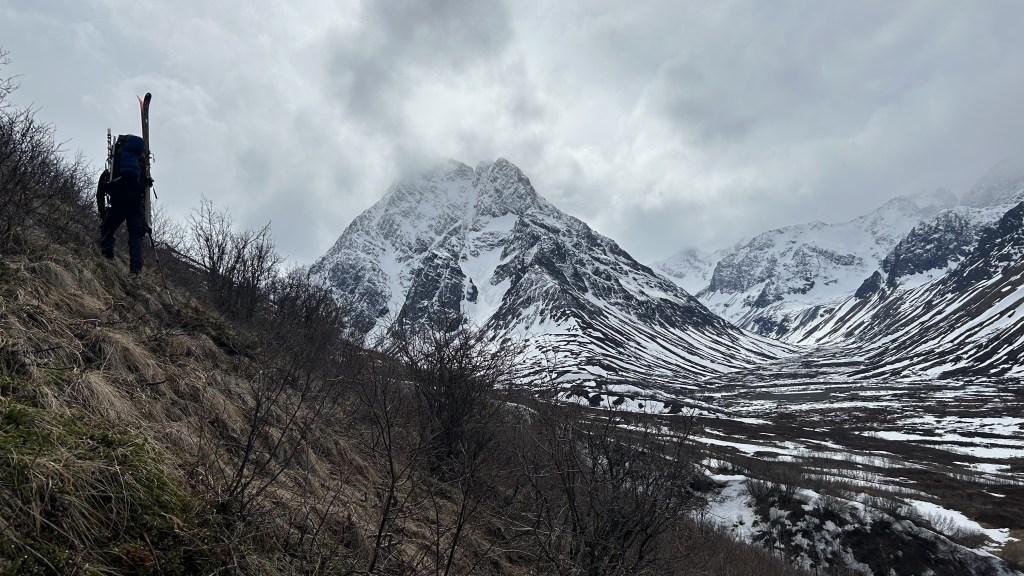
Throughout the night we got blasted with wind and snow; however, the next morning we were treated to amazing views of where we had come from. The goal was to make it more than halfway down the ridge, but with so much uncertainty we were mentally ready to only move a few miles. As we began, we found the new snow to be high quality to skin on.

We were making very good progress, staying on our skis for the whole first half of the day. We were skin skiing on downhills and sidehilling around rocky peaks when necessary. Eventually, the ridge choked down to a knife’s edge. Here we threw our skis on our backs and began bootpacking the ridge. The ridge was 3,000 feet over the valley floor to either side with no hopes in arresting a fall, so full focus was required. While the movement was not hard, the exposure made it engaging. After the knife’s edge widened, we found a steep snow climb that introduced more fun movement. We ended up booting for about 3 miles, and were relieved to find skiable terrain ahead of us.
We continued on for a few more miles, rather exhausted, but motivated to take what progress we could get. We built camp in the most protected place we could find. At camp we got blasted by wind, but a short walk away from camp proved we were in the best spot.
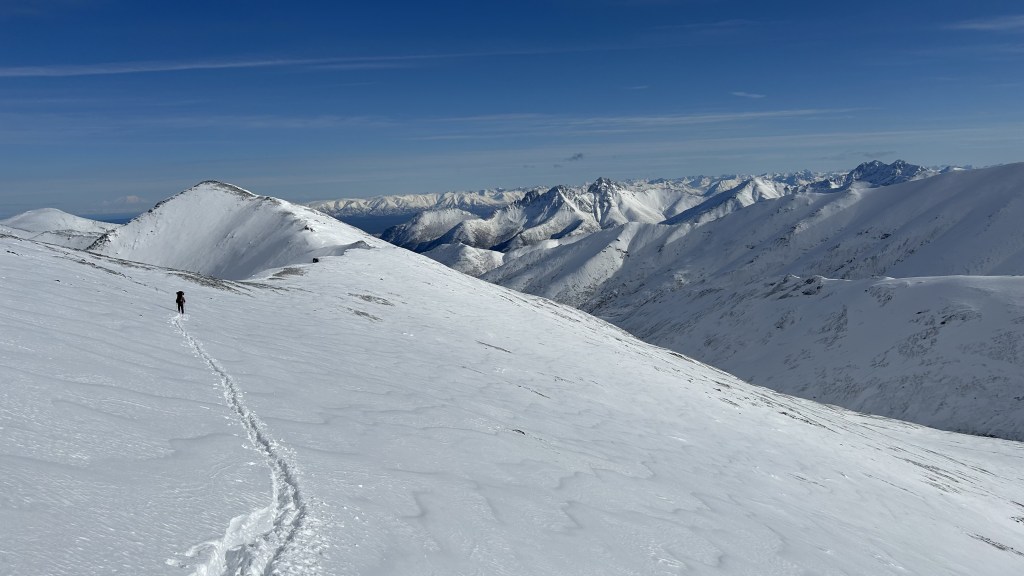
The next morning we woke and started our day in the same wind we fell asleep in. We were around 5 miles from the road, but the winds chose to make those 5 hard miles. We started the day with a downhill ski, and at our transition we watched the winds rip any last loose snow off the ridgetops all around us. As we made our way to the next high point, we began to feel more like the loose snow than humans with heavy packs. I got blown over on the ridge, but we continued to climb, hoping it would improve on the backside. No improvement was found, and we estimated we were dealing with winds of at least 75mph. After 2 miles of demoralizingly slow progress and multiple falls due to the wind, we started to look for a way down the ridge.
We eventually found a line of snow that led a good bit of the way down the north slope of the ridge. We saw the Four Mile Creek trail on the map, and put our faith in it. We skied what we could and continued booting down to the creek from there. Soon enough, we found the trail and followed it out. From where we connected with the trail, we were around 4.5 miles from the road.
The scent of the exit was in the air, and being out of the wind gave us the energy to make the miles very quickly. On the trail we began seeing some people, the first of the whole trip. Just after 2pm we reached the parking lot where we dropped our bags and waited for a ride.
It was here Brian and I chatted about hanging up the skis for the season. After a full spring mountaineering season including trips into the Wrangells and Deltas, I did not feel the need to take another step in ski boots. While the trip was not successful on paper, the group dynamic was impeccable and the scouting we achieved on the trip will surely prove valuable for our next attempt at Rumble.

 Kip Sprout
Leave a comment